
Introduction
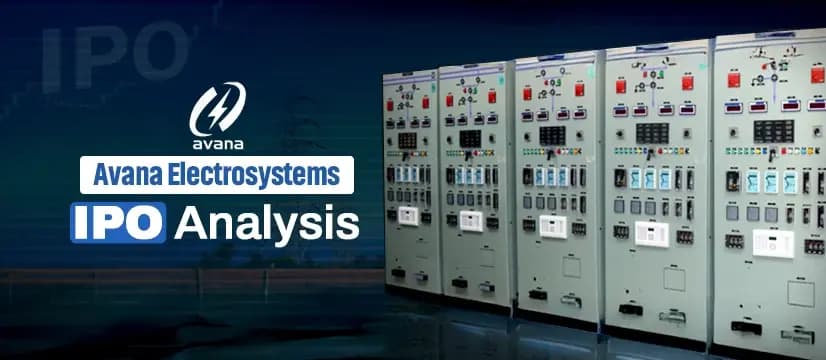
Avana Electrosystem Ltd. is a promoter-led electrical equipment company specialising in control & relay panels and MV/HV switchgear for utilities, EPCs, and industrial customers, operating in a project-driven, execution-focused market.
Let's explore this further:
Before the Deep Dive: What’s Working — and What Isn’t
Industry Analysis: Power and Switchgear Sector
Power Sector Dynamics The Indian economy, currently the world's fourth-largest, is demonstrating resilience with a projected real GDP growth of 6.5% for FY25,. This economic expansion is intrinsically linked to the power sector, where India ranks as the third-largest producer and consumer of electricity globally. As of April 30, 2025, India’s installed power generation capacity stood at 472.5 GW, with electricity demand projected to grow at 6–6.5% CAGR over the next five years. Importantly, this demand growth is not just volumetric but structural—driven by electrification of transport, data centers, industrial automation, urban infrastructure, and renewable integration. A key inflection point for the sector is India’s commitment to achieve 500 GW of non-fossil fuel capacity by 2030. This transition requires significant upgrades across transmission, distribution, and grid management, translating into an estimated ₹40 lakh crore of cumulative investment over the next decade, spanning renewable generation, substations, transmission lines, and grid-connected electrical equipment.
The switchgear industry acts as the backbone of this electrical infrastructure, contributing approximately 7.2% to India’s manufacturing GDP and accounting for a 45% share of the capital goods sector. The industry is witnessing robust growth momentum across voltage segments. The High Voltage (HV) switchgear segment grew by a significant 28% in FY24, reaching a market size of ₹7,860 crore—nearly doubling its pre-pandemic value. Simultaneously, the Low Voltage (LV) segment recorded a 13% growth in FY23, driven by industrial expansion and infrastructure development. Exports have also surged, with the HV segment exports growing to ₹3,037 crore in FY24, indicating increasing global acceptance of Indian-manufactured electrical equipment. Avana’s, exposure is primarily toward control & relay panels and MV/HV-linked switchgear assemblies, which are less commoditised than LV products but remain execution-intensive. Across voltage classes, the industry is witnessing a gradual shift toward smart and digital switchgear, driven by grid modernisation, renewable integration, data centers, and government initiatives such as the Green Energy Corridor, RDSS, Saubhagya scheme and Make in India.
Despite the optimistic outlook, the industry faces headwinds including supply chain disruptions caused by geopolitical tensions and volatility in raw material prices. Furthermore, the sector is grappling with the urgent need to align with global environmental goals, specifically the phasing out of SF6 gas (a potent greenhouse gas used in switchgear) and adopting net-zero compliant technologies. However, the absence of legally enforceable net-zero regulations in India is currently slowing the adoption of these cutting-edge, eco-friendly alternatives. To sustain competitiveness, manufacturers are increasingly required to invest in R&D to develop compact, efficient, and green switchgear solutions.
Business Model
Incorporated on July 16, 2010, in Bengaluru as Avana Electrosystems Limited, the company was established by four promoters—Anantharamaiah Panish, Gururaj Dambal, S Vinod Kumar, and K N Sreenath—who leveraged their extensive electrical engineering experience to transition the business from offering power system solutions to manufacturing specialized Control and Relay Panels (CRP) and Relays. The company operates on a B2B model, supplying its products to state-owned power distribution companies, private energy players, EPC contractors, and dealers.
Avana is primarily engaged in the design, engineering, and manufacturing of electrical equipment used for power system monitoring, control, and protection. Avana’s core business revolves around providing customized solutions for the power transmission and distribution sectors. The company’s activities include:
Manufacturing: Production of specialized Control and Relay Panels (CRP) and various types of Relays.
Application Areas: Its products are utilized in solar power plants, wind farms, power transmission stations, electricity board substations, and power utility companies.
System Integration: The company designs and engineers Substation Automation Systems (SCADA) for high-level supervision of substations.
Export: While primarily focused on the domestic market, Avana has recently commenced exporting products to a customer in Kuwait in the fiscal year 2025-2026.
CRPs and Relays are essential for the protection of valuable substation equipment such as transformers and feeders. They are designed to detect electrical faults—such as short circuits or overloads—and execute protective actions to isolate the problem, thereby preventing damage to the infrastructure, CRPs act as the "brain of the substation". They house the protection relays, control circuits, and interlocking logic that allow for safe switching and coordinated system operation. Without these systems, faults downstream cannot be cleared to allow work to progress safely, nor can the grid operate reliably.
Avana’s product portfolio is categorized by voltage levels and specific functions:
High and Extra High Voltage Systems (11kV to 220kV): Conventional and Bay Control Unit (BCU) based Control and Relay Panels. Feeder/Line Protection Panels, Transformer Protection Panels, Bus-Bar Protection Panels, and Capacitor Bank Protection Panels.
Medium Voltage Systems: Includes both indoor and outdoor type control and relay panels for feeder protection and bus couplers.
Relays: Numerical Protection Relays: Microprocessor-based devices that combine protection, monitoring, and control functions. These are SCADA compatible and compliant with IEC 60255 standards.
Electromechanical Relays: Devices using electromagnetic coils for switching operations, used for monitoring functions associated with power system protection.
Automation and Accessories: Substation Automation Panels utilizing SCADA architecture, Relay Test Blocks, Test Plugs for on-load testing, and Semaphores with LED indicators.
Avana operates two manufacturing facilities located in the Peenya Industrial Area, Bengaluru, Karnataka, both of which are ISO 9001:2015 certified.
1. Unit I: Relay Manufacturing
Focus: Design and manufacturing of Numerical Protection Relays, Electromechanical Relays, and Annunciators.
Installed Capacity: 70,000 units per annum.
Capacity Utilisation (FY 2025): 94.50%, producing 65,840 units.
2. Unit II: Control and Relay Panels (CRP)
Focus: Design, engineering, assembly, wiring, and testing of Control and Relay Panels and Substation Automation Systems.
Installed Capacity: 600 units per annum.
Capacity Utilisation (FY 2025): 87.16%, producing 523 units.
Future Expansion Plans: Avana intends to consolidate its operations by relocating both existing leased units to a single, new integrated manufacturing facility on land allotted by the Karnataka Industrial Areas Development Board (KIADB). This proposed expansion aims to significantly increase installed capacity to 1,75,000 units for Relays and 1,500 units for Panels.
Revenue Streams & Mix
Avana has demonstrated modest growth in its scale of operations over the last three fiscal years. The Revenue from Operations increased from ₹28.40 Cr. in FY 23 to ₹61.48 Cr. in FY 25, resulting in a YoY revenue growth of 16.04% in FY 2025 and 86.53% in FY 2024.
The company generates revenue primarily through the sale of manufactured goods, with a marginal contribution from services.
Sale of Products (Domestic Sales): Contributes the majority of revenue, amounting to ₹61.19 Cr. in FY 25.
Sale of Services: Includes service charges, contributing ₹0.29 Cr. in FY 2025
Revenue Mix by Sales Channel
Competitive Strategies and Order Book
Avana Electrosystems Limited demonstrates strong revenue visibility with a pending Order Book valued at ₹45.05 Cr. as of August 31, 2025. To bolster its competitive position and execute this order pipeline efficiently, the company is pursuing a strategic consolidation by relocating its two existing leased units into a single integrated manufacturing facility, aiming to streamline operations and optimize resource utilisation. Complementing this operational shift, Avana is aggressively expanding its geographical footprint by establishing regional offices in Western, Eastern, and North-Eastern India and strengthening its dealership network to capture market share from smaller panel builders. Furthermore, the company is diversifying its revenue streams by tapping into export markets—evidenced by a recent order from Kuwait—and leveraging its in-house R&D team of 9 engineers to broaden its product portfolio and meet evolving industry trends.
Management + Promoters
Avana is led by four promoters who collectively hold 99.99% of the pre-offer equity and possess over two decades of industry experience. The promoter group comprises Anantharamaiah Panish (Managing Director), Gururaj Dambal (Whole-time Director), S. Vinod Kumar (Whole-time Director) and K. N. Sreenath (Promoter), all of whom are actively involved in execution, tendering, customer relationships, and project delivery.
Anantharamaiah Panish, as MD, oversees overall strategy and execution, while Gururaj Dambal and S. Vinod Kumar focus on operations, engineering, and project management. K. N. Sreenath is involved at the promoter level with limited executive disclosure.
Financial Analysis (₹ in Cr, except for %)
The company has delivered strong growth over FY23–FY25, with revenues rising from ₹28.40 Cr to ₹61.48 Cr, supported by higher execution intensity and improved asset utilisation, as reflected in the increase in net fixed asset turnover to 18.86x. Profitability scaled meaningfully, with EBITDA margins expanding from 6.8% to 20.4% and PAT margins improving to 13.5%, indicating operating leverage and better project execution.
Improved earnings translated into stronger return ratios, with ROE rising to 47.1% in FY25, alongside a deleveraging balance sheet. Total borrowings declined from ₹9.27 Cr in FY24 to ₹5.68 Cr in FY25, resulting in a sharp improvement in debt-to-equity to 0.26x, strengthening financial flexibility.
The business remains working-capital intensive, with net working capital gap increasing to ₹18.50 Cr, driven by elevated inventory (167 days) and receivables (126 days) inherent to a project-based, EPC-linked model, constraining cash generation and increasing dependence on timely customer collections. While leverage has reduced meaningfully (D/E at 0.26x), cash conversion remains a key risk, and sustained improvement will depend on tighter working-capital discipline as the business scales further.
The new facility typically face initial stabilisation challenges, including sub-optimal capacity utilisation, teething inefficiencies, and incremental fixed costs before revenue normalisation.As a result, near-term benefits from the new plant are likely to be back-ended, while the balance sheet bears upfront pressure in the form of elevated inventory levels and delayed cash conversion.
Competitive Landscape
Avana’s competitive positioning is not scale-led but qualification- and execution-driven, with entry barriers arising from customer approvals, tender compliance, and repeat relationships rather than proprietary technology. In MV and control panel segments, competition is largely tender-based, where pricing pressure is balanced against delivery timelines, quality consistency, and approval status. Compared to unorganised players, Avana benefits from better process discipline and approval credentials; however, relative to larger organised peers, it lacks brand-led pricing power and technological differentiation. As a result, sustained competitiveness hinges on execution reliability, working-capital management, and the ability to maintain approvals and repeat order flow, rather than margin expansion or market-share dominance.
IPO Objective
A. Consolidation and Capacity Expansion (Integrated Manufacturing Unit): The primary rationale for the capital expenditure is to overcome capacity constraints and operational inefficiencies associated with the current setup. It is projected to significantly increase installed capacity—from 70,000 to 1,75,000 units for relays, and from 600 to 1,500 units for control panels.
B. Managing Working Capital Intensity: Inventory and Receivables, the business is working capital intensive, requiring significant investment in raw materials (such as sheet metal, switchgear components, and cables) and the maintenance of inventory to fulfill urgent project requirements.
Final Words
Leadership:
Avana Electrosystems is a promoter-led electrical equipment company with promoters directly overseeing execution, approvals, and customer relationships. This hands-on approach supports delivery reliability but also results in high promoter dependence, with limited second-line leadership depth visible at the current scale.
Moat:
The company’s moat is operational rather than structural, driven by technical qualifications, utility/EPC approvals, and execution capability in control & relay panels and MV/HV switchgear. While these create entry barriers at the project level, the model remains replicable over time in a tender-driven market.
Valuation:
The IPO valuation appears fair, factoring in recent growth and margin improvement but tempered by working-capital intensity and limited pricing power. Any rerating will depend on cash-flow normalisation and ROCE sustainability, rather than earnings growth alone.
Tailwinds:
Demand is supported by power infrastructure expansion, renewable integration, grid modernisation, data centres, and industrial electrification. The new manufacturing facility improves execution capacity but has added near-term working-capital pressure.
Bottom Line:
Avana is an execution-driven power equipment play with improving scale and sector tailwinds. However, working-capital absorption, promoter dependence, and competitive tender dynamics remain key risks. Returns will hinge on the ability to convert growth into cash flows and sustain margins through the cycle.
0

9

0
Publish Date
09 Jan 2026
Category
SME IPO
Reading Time
15 mins
Social Presence


Table Of Content
Introduction
Industry Analysis: Power and Switchgear Sector
Revenue Streams & Mix
Competitive Landscape
Final Words
Tags
SME IPO
SME IPO review
AVANA ELECTROSYSTEM IPO REVIEW

Office Address: MiQB, Plot 23, Sector 18, Maruti Industrial Development Area, Gurugram, Haryana 122015
Registered Office Address: 1001, Block G1B, Pocket-1, Phase-2, Samriddhi Apartments, Dwarka Sector-18B, New Delhi-110078
Email: help@alphaamc.com • Phone: +91-93-1137-8001
Alpha Ventures Private Limited
(Formerly known as Planify WealthX Pvt Ltd)
Sponsor Name
Planify Venture LLP
Investment Manager
Fund Managers
VentureX Fund I (SME)
Disclaimer
You acknowledge and confirm that by accessing the website, you are seeking information relating to the organisation of your own accord and that there has been no form of solicitation, advertisement or inducement by the organisation. Any part of the content is not, and should not be construed as, an offer or solicitation to buy or sell any securities or make any investments or any products. No material/information provided on this website should be construed as investment advice. Any action on your part on the basis of the said content is at your own risk and responsibility.
Financial Documents
Policies
© 2024–2025 Alpha. All rights reserved, Built with ❤️ in India

