
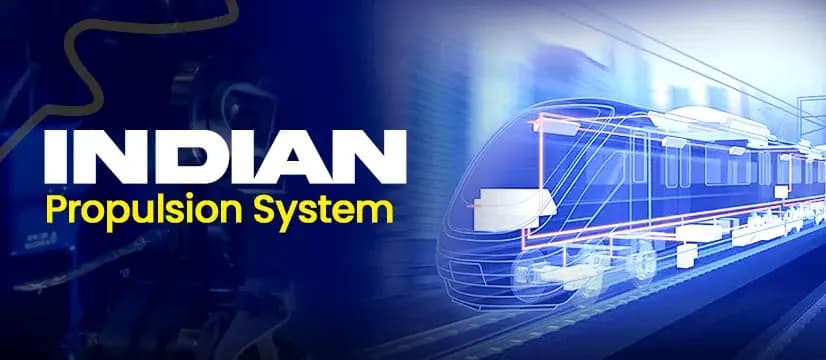
What exactly is a Propulsion system?
Ever wondered what makes a train so smooth, powerful and almost silent? And what actually makes it move? Well, that's the railway propulsion system, the heart of every locomotive and modern train. Simply put, propulsion is the engineering magic that converts energy—whether from coal, diesel, or electricity—into the raw force that turns wheels and hauls thousands of tons.
Propulsion isn't just about speed; it's the key to efficiency, lower emissions, and reliability. A good system saves millions in fuel, cuts pollution by up to 90% compared to diesel, and lets trains accelerate faster while hugging curves better. In India, where railways carry 8 billion passengers yearly, smarter propulsion means fewer delays, greener travel, and room for growth.
Let's First Understand the Basics of a Railway Propulsion System:
Think of a railway propulsion system like a car's engine and gearbox combined—but way more powerful. In simple terms, it's everything that turns energy into motion for a train. Fuel or electricity goes in one end, and smooth tractive effort (pulling force) comes out at the wheels.
Break it down into three main parts:
Prime Mover (Energy Source): The "fuel tank", which could be a diesel engine burning fuel onboard, overhead electric wires (25 kV AC in India), or even hydrogen fuel cells. This creates raw power.
Transmission/Power Conversion: The "brain." Converts that power into usable form. Diesel trains use generators to make electricity; electric ones use transformers and inverters to tweak voltage and frequency for smooth control.
Traction (Power at Wheels): The "muscles." Electric motors (traction motors) bolted to the axles spin the wheels, gripping rails to haul freight or passengers.
Key Components Include:
Power Collection and Protection:
Consisting of a pantograph, which is a diamond-shaped arm installed on the roof, pressing against 25 kV AC overhead catenary wires, and grabbing power through sliding carbon strips. Its quantity remains at two per 16-car train for redundancy. Right beside sits the Vacuum Circuit Breaker (VCB), instantly cutting power if lightning strikes or maintenance calls.
Traction Transformer
When the power drops to the underframe of Trailer Coaches (non-powered), the traction transformer here steps 25 kV down to ~950 V AC. One feeds two adjacent Motor Coaches. Think voltage like water pressure—too high fries electronics, too low lacks punch.
Power Electronics: Converters and Inverters
A Line & Traction Converters (LTC), placed under Motor Coach underframes, converts 950 V AC into DC via link capacitors. The DC is then Invert into variable-frequency 3-phase AC, along with handling of regenerative braking.
IGBT modules, which are transistors, are placed inside switches millions of times per second—modern brains enabling precise torque.
Traction Motors and Mechanical Drive
The payoff: 4 traction motors per Motor Coach, axle-mounted on bogies, convert electricity to torque, spinning wheels via gearboxes. Current returns via rail earthing brushes. Adhesion, which is just a grip, hits 35-40%—enough to pull 1,500 tons uphill.
Auxiliary Systems
This is meant for non-traction needs, where an Auxiliary Converter under Trailer Coach splits power: 415 V AC for HVAC/lights, 110 V DC for controls/toilets. Air compressor powers brakes; batteries handle emergencies. Roof-mounted units house relays and junctions.
Brief History of the Propulsion System:
Railway propulsion didn't just happen overnight—it evolved through trial, error, and brilliant engineering over two centuries. Each leap fixed the last one's flaws, paving the way for today's electric marvels.
The journey started with steam locomotives in the 1800s—boilers boiling water to push pistons connected to wheels. Then came diesel-electric giants, where a diesel engine spins a generator to power electric motors at the axles. Today, pure electric rules with overhead wires feeding high-tech AC motors, and the future whispers hybrids and hydrogen for zero-emission routes.
Steam Era (1820s-1950s):
Picture the 1820s: George Stephenson's Rocket chugs along at 30 mph. How it worked: A firebox burns coal to boil water in a boiler, creating high-pressure steam. That steam rushes into cylinders, pushing pistons connected by rods to the drive wheels—like a giant steam-powered seesaw.
The steam era, however, ruled only until the 1950s, but hit a wall against modernisation needs.
Diesel and Diesel-Electric Era (1930s-1990s):
Early 1900s experiments used diesel engines with gearboxes or hydraulic fluid transmissions. Simple, but clunky—hard to control torque across speeds, poor for heavy freight.
1930s onwards, Diesel-electric changed everything: A diesel engine runs at constant optimal RPM, spinning a generator to produce electricity. That powers traction motors at each axle. No mechanical linkage needed.
It dominated because of Control, torque and Flexibility. India's WDM-2 class (still running) exemplifies this—reliable workhorses hauling freight for decades.
Electric Traction Era (1950s- Present):
Starting in the 1950s, these trains had a power delivery system with no onboard fuel. Trains grab electricity from overhead catenary wires (25 kV AC in India) via pantographs, or a third rail (metros)
Further, it can be classified into AC vs DC traction, with DC running on fixed voltage but losing torque at high speeds. AC motors (modern) use inverters for variable frequency—full torque across all speeds, no brushes to wear out.
It is advantageous in terms of its high efficiency, lower emissions and better accelerations. India's shift to WAP-7/WAG-9 AC locos shows this in action—pulling heavier loads faster, greener.
Types of Railway Propulsion Technologies Today
Modern railway propulsion offers diverse options for different needs. Electric leads high-density routes, diesel handles remote areas, and green tech fills gaps.
Pure Electric Locomotives
These powerhouses drive India's nearly 100% electrified broad-gauge network. They draw 25 kV AC from overhead wires via pantographs, with transformers stepping down voltage and inverters generating 3-phase AC for axle-mounted motors. At 85-90% efficiency with zero track emissions, they deliver unmatched performance for modern rail demands.
Diesel-Electric Locomotives
Despite a ‘diesel’ label, these locos actually run electric motors at the wheels. The diesel engine turns an alternator to make power onboard, then inverters send it smoothly to the traction motors. You get torque right from a stop and easy speed control. Take India's WDG-4G at 4,500 HP—it hauls freight where wires haven't reached yet, making up 24% of the fleet, though that's dropping as lines go electric.
Multiple Units: EMUs, DMUs, Metro Trains
Self-propelled trainsets spread the power around—no single loco up front. EMUs like Mumbai locals stick motors in every third coach for quick getaways. DMUs handle those branch lines without wires. Metros grab DC from third rails. Vande Bharat takes it up a notch: 16 cars with 8 powered ones, hitting 180 km/h tops, plus regenerative braking that puts energy back.
Emerging Propulsion: Battery, Hydrogen, Hybrid
Battery trains running 100-200 km emission-free post-charge. Consider them as an emerging future technology with Hydrogen fuel cells, emitting water, 1,000+ km range. India plans 35 units. Hybrids mix diesel/battery, cut fuel 30-50% via energy capture.
Electric for density, diesel for reach, and emerging tech for a green future.
Global Railway Propulsion Industry: Market Value and Growth
Current Global Market Size (2024):
The worldwide railway propulsion systems market stands at USD 10.51 billion, making it a significant segment within the broader global rail and transport infrastructure. This encompasses locomotives, EMUs, metro trains, high-speed rail, and all associated propulsion components (transformers, inverters, traction motors, control systems)
Projected Growth Rate: 5.0% CAGR (2024-2031)
Global propulsion is expected to grow at 5.0% CAGR—slower than India's 8.8% but reflecting mature markets balancing with rapid Asia-Pacific expansion.
Global propulsion systems: USD 10.51B (2024) → USD 14.79B (2031), 5.0% CAGR
Global locomotive market: USD 13.80B (2024) → USD 24.85B (2032), 8.1% CAGR
Global traction motors: USD 12B (2024) → USD 20B (2035), 4.8% CAGR
By 2035, the global propulsion market will nearly double from USD 10.51B to USD 17.5B+.
Regional Market Breakdown
Asia Pacific (India & China) is the global growth engine, driving 7.0% CAGR vs 3-4% in mature markets.
Growth Drivers Globally
Electrification Expansion: Europe achieving 39-50% (UK 40%), China 82%, India 99.2%—still a massive opportunity in Africa/LATAM.
Freight Corridor Boom: Global freight demands up 3-5% annually. Dedicated freight corridors (India DFC, China Railway, European corridors) need modern propulsion.
Urban Metro Explosion: 500+ metro systems globally; metro segment fastest-growing application at 8-10% CAGR. Requires lightweight, low-noise AC traction motors.
Decarbonization Mandates: EU "Fit for 55" package: 55% carbon reduction by 2030 to 100% electric/hydrogen locomotives. The US enforces strict emissions regulations, along with $110B rail investment (Biden infrastructure)
Green Hydrogen Entry: First commercial trains (Alstom iLint) running in Germany/UK; global hydrogen propulsion market emerging at 12-15% CAGR.
Indian Context: How Propulsion Looks on Indian Railways
India's railways—the world's fourth largest network—show propulsion in action at a massive scale. With 1.4 million employees and 8 billion passengers yearly, propulsion choices balance density, cost, and green goals.
India's railway propulsion systems market, valued at $ 290.18 million in FY24, is expected to grow with 8.8% CAGR till FY33. This encompasses complete propulsion packages—pantographs, transformers, Line/Traction Converters, traction motors, inverters, and auxiliary systems fitted to locomotives, EMUs, and metro trains.
Current Mix of Locomotives
Broad picture: While the Electric locos dominate at around 75% (10,200+ units), diesel-electric (4,100+ units) are left just at 24%.
Role of diesel-electric today: Handles remaining 1% non-electrified routes (branch lines, construction zones) and contingencies like power failures. WDG-4G (GE, 4,500 HP) pulls freight where wires don't reach; WDM-3A serves passengers. Reliable but fuel-guzzling—phasing out fast.
Electrification progress: 99% broad-gauge done (69,102 rkm by Nov 2025). Pace hit 15 km/day average. Means propulsion shift: diesel generators → overhead wire transformers. Same trains are now electric, saving ₹20,000 crore of diesel yearly.
Electrification Drive and Propulsion Shift
Full electrification kills diesel dependency. WAP-5/WAG-9 AC locos replace older DC models—higher torque (35% adhesion), regenerative braking (20% energy savings). Infrastructure follows: 2x25 kV upgrades double capacity. Result? Freight from 1,300 MT to 3,000 MT by 2030.
What about the Government Initiatives?
The Indian government has aggressively pushed railway propulsion through electrification and manufacturing incentives, aiming for net-zero emissions ahead of schedule. Mission 41K and the National Rail Plan (Vision 2024) target 100% broad-gauge electrification by FY 2025-26, already at 99.2% (69,102 km by Nov 2025)—surpassing the UK (39%) and China (82%).
This shifts propulsion from diesel-electric to pure electric AC systems, saving ₹20,000 crore annually in diesel while enabling regenerative braking (20-30% energy recovery). Budget 2025 allocates ₹22,444 crore for JVs/PSUs, funding 200 Vande Bharat, 100 Amrit Bharat, and 50 Namo Bharat trains with IGBT-based 3-phase propulsion.
PLI Scheme for Railways (2023) incentivises local propulsion component manufacturing—coaches, engines, traction motors, inverters—with 4-6% sales-based rewards over 5 years. It counters ₹42,500 crore imports (wheels, axles), boosting BHEL, Titagarh-ABB, Siemens-India JVs. Expected: 1.4 lakh jobs, ₹2.3 lakh crore incremental sales. Tech upgrades like 2x25 kV systems and HOG (Head-on-Generation) cut station pollution.
Renewable push: 812 MW solar, 93 MW wind by Nov 2025; 10 GW traction power by 2030 (3 GW renewables). "Hydrogen for Heritage" plans 35 fuel-cell trains. These make India a propulsion export hub, targeting 40% global rail activity by 2050.
Industry structure: who makes money in India’s Propulsion ecosystem
India's railway propulsion sector features a mix of PSUs, private firms, and foreign JVs manufacturing traction motors, inverters, converters, transformers, and complete systems for locomotives/EMUs. The players can be categorised into two categories: Complete Propulsion System makers and just core component makers (like motors and converters).
India’s railway propulsion industry has a layered structure: big PSUs, aggressive private manufacturers, and foreign technology partners, all supplying complete propulsion systems, traction motors, converters, and transformers.
Public-Sector & Large Domestic Players
BHEL (Bharat Heavy Electricals Ltd)
BHEL is the backbone PSU for propulsion, supplying traction motors, IGBT-based converters, transformers, and control gear for electric and diesel-electric locomotives. It leads a consortium that won the order for 80 Vande Bharat trainsets, positioning itself as a full train-propulsion integrator under Make in India.
Titagarh Rail Systems
Titagarh has moved from wagons into high-value propulsion, partnering with ABB to manufacture metro propulsion equipment, TCMS, and high-efficiency motors in India. It also teams up with BHEL for Vande Bharat trainsets, giving it a key role in EMU-style distributed propulsion.
BEML (Bharat Earth Movers Ltd)
BEML builds metro and EMU coaches and increasingly integrates propulsion packages supplied by partners, acting as a key rolling-stock OEM to cities like Delhi, Bangalore, and Kolkata. Its role is as a system integrator, marrying mechanical coach design with traction and auxiliary systems.
Specialised Propulsion & Component Companies
Medha Servo Drives
Medha is a Hyderabad-based electronics specialist providing traction motors, alternators, auxiliary converters, and complete propulsion packages for locomotives and EMUs. It has supplied propulsion systems for various Indian Railways projects and is known for in-house control electronics and software.
MV Electrosystems
Where VentureX is invested in, MV Electrosystems focuses on traction transformers and related windings used in locomotives, EMUs, and metro trains. Localising large power transformers, it reduces dependence on imported high-voltage equipment.
In March 2024, MVEL delivered its first indigenously developed 6,000 HP 3-phase propulsion system to Chittaranjan Locomotive Works (CLW) for AC electric locomotives—after 4 years of R&D. This IGBT-based system includes traction converters, auxiliary converters, vehicle control units (VCUs), and driver displays, all designed in-house to meet global safety standards.
The company’s core products include complete propulsion packages for electric locomotives, EMU, MEMUs and metros.
Talking about its ambitious growth strategies, the company plans to build a new Unit 2 factory in Nangla Bhiku, Palwal, for high-volume production following CLW's approval of their 6,000 HP 3-phase propulsion system, while allocating ₹180 crore from IPO proceeds for working capital to manage 2–3-year order cycles with Indian Railways.
Another ₹210 crore targets R&D for next-gen products like hotel-load converters, EMU propulsion kits, lightweight traction motors, and AI-enabled Vehicle Control Units with EtherCAT integration.
Hirect / Other Motor Manufacturers
Several domestic firms—such as Hirect and other listed traction-motor makers—supply AC traction motors, alternators, and auxiliary machines to loco works and private OEMs. These players form the mid-tier backbone of motor and generator supply for both mainline and metro applications.
Case Study: The Prestigious Vande Bharat Express
What's Special About Vande Bharat?
Vande Bharat stands out as India's first self-propelled semi-high-speed train, cleverly distributing propulsion across 8 of its 16 coaches instead of relying on a traditional front locomotive. With over 150 units now zipping along more than 50 routes, it comfortably cruises at 160 km/h, shaving off 20-30% from journey times compared to older trains.
The real magic lies in its modern propulsion setup: pantographs on the roof snag 25 kV AC power from overhead wires, transformers tame it down to a usable 950V, and smart IGBT converters whip up 3-phase AC to feed the 32 traction motors. This lets it rocket from 0-100 km/h in just 52 seconds while regenerative braking recovers 30% of the energy, hitting an impressive 87% overall efficiency.
Passenger perks: Rotating seats, Wi-Fi, bio-vacuum toilets, auto doors, KAVACH safety, flood-proof (400mm water). Quieter electric hum vs diesel roar.
Make-in-India: ICF-built at ₹1.2B per set. BHEL-Titagarh powers 80+ units. Future: Sleepers (2026), 200 km/h upgrades. 150+ Vande Bharats running by 2025, expanding to sleeper variants. Shows India's propulsion leap: from single heavy locos to lightweight, efficient trainsets.
Electrification + modern EMUs = India's rail future: greener, faster, smarter.
Major Challenges Faced by The Propulsion Industry
Till now, the propulsion may sound perfect, but real-world engineering demands tough choices. High-tech systems shine long-term but test budgets, skills, and supply chains upfront. Let’s discuss some of the major such challenges-
High upfront cost vs long-term savings: Electric propulsion costs 2-3x more initially (₹20-30 crore per loco vs ₹10-15 crore diesel). Wiring 1 km catenary? ₹10-15 crore. But lifetime savings hit ₹20,000 crore yearly for India via diesel elimination. Payback: 5-7 years through 85% efficiency and no fuel.
Maintenance and skill requirements: IGBT inverters need cleanrooms; traction motors demand precision alignment. India's 1.4M rail workers train for AC systems, but legacy DC skills fade. Vande Bharat depots cost ₹500 crore each—specialised tools, imported spares until local manufacturing scales.
Dependence on power electronics and semiconductor supply: 56% loco cost is IGBT modules. Global chip shortages (2021-2023) delayed deliveries. India imports 70%—BHEL/Titagarh partnerships help, but SiC tech lag risks 10-15% cost hikes.
Integration with signalling, braking, safety systems: Propulsion must sync with ETCS/ETTC signalling, regenerative brakes, and ATP safety. Mismatch? Delays or failures. Vande Bharat's TCMS coordinates 8 motor coaches—software bugs cascade across the train.
Balancing weight, efficiency, reliability: Lighter motors save fuel but risk overheating. Oil-cooled transformers (4,900 kg) boost reliability but raise axle loads (22.9t limit). AC systems excel in torque but vibrate more than DC—trade-off solved via suspension design.
Engineers juggle these daily. India's success? Massive capex + local partnerships turning challenges into a competitive edge.
Conclusion
Railway propulsion boils down to this: smart engineering turning energy into motion. From pantographs grabbing overhead power to traction motors gripping rails, it's the system making trains efficient beasts—85% energy use vs diesel's 35%, zero track emissions, acceleration that leaves cars behind.
It underpins speed (Vande Bharat's 180 km/h), efficiency (₹20,000 crore diesel savings), and decarbonization (India's 99% electrification leap). Challenges like high costs and skills? Offset by 8.8% market growth and local manufacturing muscle.
India stands unique: near-100% electrified network + BHEL/Titagarh factories churning AC systems. From steam chugs to hydrogen dreams, propulsion evolution mirrors sustainable mobility's arc—greener freight, faster passengers, global exports ahead.
Trains aren't just transport; propulsion makes them tomorrow's backbone.
0

21

0
Publish Date
31 Dec 2025
Reading Time
15 mins
Social Presence


Table Of Content
What exactly is a Propulsion system?
Brief History of the Propulsion System:
Types of Railway Propulsion Technologies Today
Growth Drivers Globally
Case Study: The Prestigious Vande Bharat Express
Tags
IndustryAnalysis
Industryoverview
SMECompanies

Office Address: MiQB, Plot 23, Sector 18, Maruti Industrial Development Area, Gurugram, Haryana 122015
Registered Office Address: 1001, Block G1B, Pocket-1, Phase-2, Samriddhi Apartments, Dwarka Sector-18B, New Delhi-110078
Email: help@alphaamc.com • Phone: +91-93-1137-8001
Alpha Ventures Private Limited
(Formerly known as Planify WealthX Pvt Ltd)
Sponsor Name
Planify Venture LLP
Investment Manager
Fund Managers
VentureX Fund I (SME)
Disclaimer
You acknowledge and confirm that by accessing the website, you are seeking information relating to the organisation of your own accord and that there has been no form of solicitation, advertisement or inducement by the organisation. Any part of the content is not, and should not be construed as, an offer or solicitation to buy or sell any securities or make any investments or any products. No material/information provided on this website should be construed as investment advice. Any action on your part on the basis of the said content is at your own risk and responsibility.
Policies
Resources
© 2024–2025 Alpha. All rights reserved, Built with ❤️ in India


