
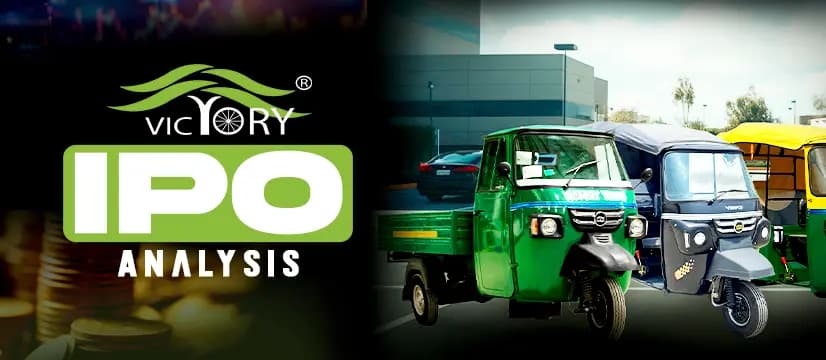
Victory Electric Vehicles International Ltd. is coming with an upcoming IPO of ₹34.56 crore — a profitable EV player on paper, but one where weak cash flows and muted growth temper the excitement.
Let’s explore further:
Before the Deep Dive: What’s Working — and What Isn’t
Now that you’ve seen the snapshot, let’s unpack the full story behind these numbers and understand the business in context.
Indian Electric Vehicle Industry Overview: Growth, Policies and Outlook
India’s EV story is no longer about “potential.” It’s about scale. From a market that was barely a few billion dollars in the early 2020s, the Indian EV industry is now compounding at over 60% annually, making it one of the fastest-growing EV markets globally. Policy has been the real catalyst—FAME-II subsidies, PLI incentives for batteries, lower GST, and aggressive state EV policies have pushed the EV sector up a notch.
The government’s 2030 targets—up to 80% electrification in two- and three-wheelers and 70% in commercial vehicles- aren’t aspirational anymore; they’re shaping capacity decisions today. As adoption accelerates, batteries are emerging as the real bottleneck and value pool, with the Indian EV battery market expected to cross US$27 billion by 2028. The next leg of growth won’t be about who enters the EV space, but who can execute at scale, control costs, and turn policy tailwinds into durable profitability.
Company Overview & Origin Story
Victory Electric Vehicles was set up in 2018, right when India’s EV conversation was still more policy talk than real adoption. Promoted by Sanjay Kumar Popli along with Seema and Palak Popli, the company started with a clear intent: build electric vehicles suited for Indian roads, price points, and daily use rather than chasing premium experiments.
As demand visibility improved and the EV ecosystem matured, Victory transitioned from a private company to a public limited entity in 2020, signalling a shift from early-stage execution to scale and structure. What began as a small, focused EV manufacturer is now positioning itself to ride India’s next phase of mass EV adoption, backed by policy support and expanding market demand.
Product Portfolio of Victory Electric Vehicles: E-Rickshaws, L5 Autos and EV Scooters
The company manufactures electric vehicles ranging from E-rickshaws, E-Cargo/Loader E -Rickshaws, Scooters etc. Their portfolio extends beyond conventional offerings to include customized E-Three Wheelers, catering to specific needs such as Food Three Wheelers and Ice Cream Three Wheelers etc. Details of the products include:
Electric Rickshaws (E-Rickshaws)
This is Victory’s core volume driver. These vehicles are designed for short-distance passenger transport in cities and semi-urban areas where affordability and uptime matter more than fancy specs. These run at around 25 km/h top speed, seating a driver plus passengers and designed for easy city riding with swappable batteries and robust steel frames. They cater mainly to individual drivers and small fleet owners who want quick payback and daily income stability.
L5 Electric Three-Wheelers (Passenger)
These are upgraded, higher-powered electric autos compared to standard e-rickshaws. L5 vehicles are meant for longer routes, better ride comfort, and higher passenger loads, making them suitable for city autorickshaw replacement. This segment directly benefits from government push toward replacing ICE autos and is more regulated, which raises entry barriers slightly.
Electric Cargo / Load Three-Wheelers
Victory also targets last-mile delivery and small commercial transport through electric cargo three-wheelers. Typical variants run up to about 23 km/h, with a GVW ~710 kg and payloads around 300–400 kg, making them practical for kirana restocks, parcel drops, and other last-mile work. With e-commerce and hyperlocal delivery growing, this category is seeing steady demand, especially in urban clusters.
Electric Scooters (E-Scooties)
This segment caters to personal mobility and short urban commutes. Victory’s electric scooters are positioned as budget-friendly alternatives to petrol two-wheelers, focusing on ease of use, low maintenance, and everyday practicality rather than performance riding. It helps the company diversify beyond three-wheelers but remains a smaller part of the mix.
Revenue Mix Analysis: Product-wise Contribution and Dependence on Three-Wheelers
The revenue mix clearly shows Victory’s heavy dependence on three-wheelers, which consistently contribute over half of total revenue and peaked above 90% in FY24. FY25 marks a visible shift, where L5(Electric Autorickshaw) vehicles emerged as a meaningful contributor, signalling a move toward higher-value, regulated segments. Two-wheelers and spare parts remain ancillary, indicating that near-term growth is still driven by commercial mobility rather than personal EV adoption.
Geographic Revenue Concentration: State-wise Sales Exposure Explained
Victory’s revenues are geographically concentrated, with Uttar Pradesh, Delhi, and Haryana consistently contributing over 60–75% of total sales across periods. FY24–FY25 shows a sharp spike in Delhi, indicating market-specific traction rather than broad-based national penetration. While this concentration supports execution efficiency, it also exposes the business to regional demand and policy risks, making diversification a key monitorable going forward.
Business Model Breakdown: B2B vs B2C Revenue Mix
Victory’s business model is clearly B2B-heavy, with over 90% of revenues consistently coming from institutional, dealer, and fleet-led demand. B2C contribution remains small and volatile, indicating that the company is still not meaningfully exposed to direct consumer demand. What this really means is that revenue visibility is strong, but scaling retail presence will be the next growth lever to watch.
Manufacturing Capacity and Utilisation: Is Expansion Running Ahead of Demand?
Overall utilisation has cooled from the FY24 peak, slipping to ~59% by Sep-25, indicating capacity expansion has outpaced near-term demand. The L3 e-rickshaw segment remains the core engine, consistently operating at a healthy 70–80% utilisation and anchoring volumes. L5 vehicles are still in the ramp-up phase, with low utilisation reflecting early-stage scaling rather than failure, while two-wheelers remain non-core with volatile demand.
Management + Promoters
Victory Electric Vehicles is promoted by Sanjay Kumar Popli, Seema Popli, and Palak Popli, who have led the company since its inception and remain deeply involved in operations and growth.
Promoter holding stands at 97.4% pre-IPO and will reduce to 63.3% post-IPO, ensuring meaningful dilution while retaining majority control. This keeps promoter accountability intact while improving public float and governance visibility.
Financial Performance
Despite a visible improvement in reported profitability, Victory Electric Vehicles fails to clear the quality threshold for a positive investment view. Revenue growth remains inconsistent, with FY25 recovering only ~5% after a sharp FY24 decline, indicating a lack of sustained demand momentum. The business still appears volume-dependent rather than structurally scalable.
More importantly, cash flow quality is poor. Working-capital metrics have deteriorated materially—receivable days have stretched to 116 days in FY25 from 71 days in FY24, inventory days have doubled, and payable days have compressed. This has pushed the cash conversion cycle to an elevated 139 days in FY25, meaning earnings are increasingly locked in receivables rather than converting into cash. For a manufacturing business, this is a structural red flag.
Returns have also peaked and rolled over. ROE and ROCE were abnormally high in FY24—70.2% and 44.8% respectively, and have since declined sharply to 10.4% and 10.2% in the year till Sept 25, suggesting FY24 was not a sustainable base but a margin-led spike.
While the debt to equity has reduced from 1.5x in FY23 to 0.6x in FY25, the improvement is offset by slower growth, rising working-capital intensity, and dependence on a narrow product and geographic base.
Peer Analysis
(FY25)
Victory shows better headline margins and ROE than peers, but the quality of earnings remains weak due to a stretched cash conversion cycle of 139 days. Despite limited revenue growth, the stock is priced at a steep 30.4x P/E, which is hard to justify.
Peers don’t improve the picture—Wardwizard struggles with poor profitability and even worse cash cycles, while Tunwal looks relatively cheaper but still operates in a low-growth, working-capital-heavy space. With all three companies showing little to no revenue growth, valuation upside across the segment remains structurally limited.
Final Words
Through the LMVT Framework
Leadership: Victory is a tightly promoter-led business with hands-on execution in electric three-wheelers, but decision-making and scale remain heavily dependent on the promoter group.
Moat: There is no structural moat. Products are largely commoditised, competition is intense, and entry barriers are limited to dealer reach and pricing. Any advantage comes from execution and regional presence, both of which are replicable.
Valuation: At ~30× earnings, the IPO pricing assumes quality and growth that the business has not yet demonstrated. Margins look strong on paper, but stretched working capital and weak cash conversion dilute valuation comfort.
Tailwinds: EV adoption in three-wheelers is a genuine tailwind, supported by policy push and cost economics. However, these benefits accrue to the sector broadly, not uniquely to the company.
Bottom line: Victory is a profitable but cash-strained EV manufacturer operating in a low-moat, low-growth segment. Until revenue growth becomes durable and cash flows improve meaningfully, the risk-reward remains unfavourable. This IPO is best avoided.
0

15

0
Publish Date
06 Jan 2026
Category
SME IPO
Reading Time
10 mins
Social Presence


Table Of Content
Company Overview & Origin Story
Revenue Mix Analysis: Product-wise Contribution and Dependence on Three-Wheelers
Manufacturing Capacity and Utilisation: Is Expansion Running Ahead of Demand?
Final Words
Tags
SME IPO
SME IPO review
Victory Electric IPO
Victory Electric IPO analysis

Office Address: MiQB, Plot 23, Sector 18, Maruti Industrial Development Area, Gurugram, Haryana 122015
Registered Office Address: 1001, Block G1B, Pocket-1, Phase-2, Samriddhi Apartments, Dwarka Sector-18B, New Delhi-110078
Email: help@alphaamc.com • Phone: +91-93-1137-8001
Alpha Ventures Private Limited
(Formerly known as Planify WealthX Pvt Ltd)
Sponsor Name
Planify Venture LLP
Investment Manager
Fund Managers
VentureX Fund I (SME)
Disclaimer
You acknowledge and confirm that by accessing the website, you are seeking information relating to the organisation of your own accord and that there has been no form of solicitation, advertisement or inducement by the organisation. Any part of the content is not, and should not be construed as, an offer or solicitation to buy or sell any securities or make any investments or any products. No material/information provided on this website should be construed as investment advice. Any action on your part on the basis of the said content is at your own risk and responsibility.
Financial Documents
Policies
© 2024–2025 Alpha. All rights reserved, Built with ❤️ in India

