
Why talk about wires and cables at all?
Let’s be honest.
When someone says “wires and cables industry,” it doesn’t sound exciting. It sounds like a commodity business. Copper, plastic, coils stacked in warehouses.
That reaction is understandable, because wires and cables only get noticed when something goes wrong. When a building loses power. When a transformer trips. When a data center goes dark. Until then, they stay hidden behind walls, underground, or stretched across pylons far from view.
But that invisibility is exactly what makes this industry important.
Every unit of electricity generated in India — whether from coal, solar, wind, or hydro has to travel through wires and cables before it becomes usable. Every home that gets electrified, every factory that expands capacity, every metro line, data center, EV charger, or telecom tower adds more copper and aluminium into the system.
In that sense, wires and cables are not a “support industry.” They are the circulatory system of India’s infrastructure. And as India pushes harder on electrification, urbanisation, renewables, and digital connectivity, demand for this invisible backbone doesn’t spike once — it compounds quietly, year after year.
That’s why investors, policymakers, and manufacturers are paying closer attention to a sector that rarely makes headlines but sits at the centre of almost every growth story India is telling today.
Understanding Wires and Cables: What the Product Really Is
At its simplest, a wire is a metal conductor that carries electricity.
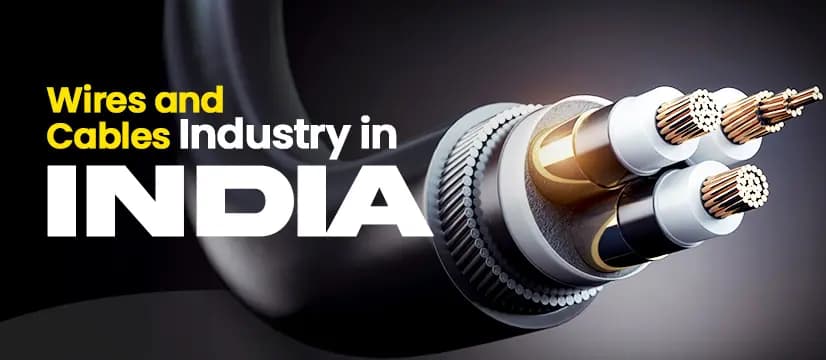
A cable is one or more such conductors, wrapped in layers of insulation, protection, and sometimes shielding.
Those layers matter more than people realise.
The metal inside which is usually copper or aluminium decides how efficiently electricity flows. The insulation decides how safely it flows. The outer sheath decides how long the cable survives heat, moisture, abrasion, chemicals, or fire. Together, these layers determine where a cable can be used, how much power it can carry, and how long it will last.
This is why not all wires are interchangeable. A thin house wire and a high-voltage transmission cable may both carry electricity, but they are designed for completely different realities.
And the single most important factor that shapes that design is voltage.
Low voltage cables are built for safety, flexibility, and dense indoor use.
Medium voltage cables balance insulation strength with reliability for distribution networks.
High and extra-high voltage systems are engineered to move massive amounts of power over long distances with minimal loss.
As electricity travels farther, voltage goes up so current can go down, reducing losses. That simple physics principle shapes the entire power grid and the wires and cables industry.
Wires and cables as infrastructure, not products:
What often gets missed is that wires and cables are not discretionary purchases.
A housing project cannot be completed without internal wiring.
A solar plant cannot evacuate power without cables.
Once infrastructure is planned, cables are not optional — they are mandatory.
That’s why demand for wires and cables doesn’t behave like consumer electronics or luxury goods.
Types of Wires and Cables in India by Voltage Level
Once you understand that voltage decides where a cable sits in the power system, the Indian wires and cables market starts to make a lot more sense. India isn’t growing in a straight line — homes, factories, renewables, metros, and data centers are all expanding at different speeds. Each of those pulls a different voltage layer.
That’s why it helps to start with voltage, and then move to how these cables are actually used.
Low Voltage (LV): where India’s scale really shows up
Typical range: up to ~1.1 kV
Where it’s used: homes, shops, offices, small commercial buildings, light industrial setups
Low voltage cables are the wires that run behind walls, through conduits, and into switchboards. In India, this segment is driven less by big-ticket government capex and more by millions of small decisions made every year: building a house, opening a shop, expanding an office, upgrading old wiring.
This is also why LV cables form the largest share of India’s wires and cables market by volume. Over 85% of the overall market sits in low and medium voltage categories, with LV alone accounting for a substantial chunk of demand.
Even when infrastructure spending slows, housing and commercial wiring rarely collapses — it just shifts between premium and mass segments. That’s why LV cables behave more like a steady compounding business than a cyclical one.
Medium Voltage (MV): the connector between generation and consumption
Typical range: ~1.1 kV to 33 kV
Where it’s used: distribution feeders, substations, industrial plants, metros, airports, campuses
Medium voltage cables sit one layer above everyday wiring. They don’t power individual appliances; they power zones — industrial estates, metro rail systems, data parks, large hospitals, and commercial clusters.
MV demand rises when cities expand outward and electricity demand becomes more concentrated. Some data show peak power demand rising sharply over the last decade, with India moving toward ~250 GW peak demand by 2025.
High Voltage, Extra-High Voltage, and HVDC: the grid backbone
Typical range: 66 kV → 220 kV → 400 kV → 765 kV and HVDC
Where it’s used: inter-state transmission, renewable evacuation, national grid corridors
This is the most capital-intensive and technically demanding part of the wires and cables ecosystem. These cables and conductors are responsible for moving electricity from generation hubs to consumption centres.
In India, underground high-voltage cabling exists, but it’s limited to specific urban or high-reliability zones because it is significantly more expensive and complex to maintain.
The 220 kV and 400 kV networks are largely mature, forming over 85% of existing transmission lines.
The real growth is now shifting to 765 kV AC lines and HVDC corridors.
According to the National Electricity Plan projections:
the share of 765 kV lines in total transmission additions is expected to rise to ~30%
total 765 kV line length is projected to increase from ~56,955 ckm to ~86,028 ckm by 2027
HVDC lines are expected to expand from ~19,375 ckm to ~23,675 ckm by 2027
This expansion is closely linked to renewable energy. India’s push toward 500 GW of renewable capacity by 2030, including ~280 GW of solar, requires long-distance, high-capacity evacuation from remote generation zones.
Use cases of wires and cables in India: where demand really comes from
In India, wires and cables are not pulled by one dominant customer group. Demand comes from housing, utilities, industry, transport, and digital infrastructure — each growing at a different pace, with different economics. That’s why understanding use cases is key to understanding the market.
1) Housing wires: the single largest demand pool
Typical use: internal wiring in homes, apartments, offices, retail spaces
Voltage: Low voltage
Market position: largest segment by volume and value
Housing wires form the backbone of India’s wires and cables market. These are the cables that run inside walls — feeding lights, fans, air conditioners, appliances, and plug points. Every new building needs them, and every old building eventually replaces them.
Because India is still urbanising, and because household electricity usage per home continues to rise, housing wires alone account for a significant share of total industry revenue. Industry estimates consistently place housing wires as one of the largest individual segments, often contributing ~32% of total wires and cables demand in India. What keeps this segment structurally strong is not just new construction, but replacement demand.
Housing wires are also where branding, dealer networks, and electrician preference matter most, which is why this segment is fiercely competitive but remarkably stable.
2) Power cables: the infrastructure core
Typical use: power transmission and distribution, underground and overhead
Voltage: spans LV, MV, HV, EHV
Market share: ~25% of total wires & cables market
Power cables are what most people imagine when they think of “infrastructure.” These cables carry electricity from substations to cities, factories, and renewable plants.
Power cables account for only about 25% of the overall wires and cables market in India.
That surprises many people, because power infrastructure sounds dominant. In reality, while power cables are strategically critical, they form a smaller share compared to mass housing and industrial wiring.
This segment is more project-driven and cyclical, tied closely to government and utility capex cycles. Growth comes in waves rather than smoothly.
3) Industrial cables: factories, automation, and process control
Typical use: manufacturing plants, refineries, cement, steel, chemicals
Voltage: LV to MV
Includes: control, instrumentation, and flexible industrial cables
Industrial cables power machines, but more importantly, they control them. Control and instrumentation cables don’t just carry electricity — they carry signals that tell machines what to do, when to stop, and how to respond.
In India, this segment grows with manufacturing capacity expansion, automation and process digitisation and industrial safety and monitoring requirements.
4) Communication cables: power’s quieter twin
Typical use: telecom networks, broadband, data centres
Voltage: very low voltage
Includes: fibre-optic cables, data cables, signal cables
Communication cables move information. And in a digital economy, that’s just as critical.
India’s communication cable demand is driven by telecom network expansion, data centres and cloud infrastructure etc.
This segment is smaller than housing or power cables today, but it is one of the fastest-growing use cases.
5) Specialty and emerging-use cables: where future growth hides
Typical use: EVs, solar plants, railways, metros, robotics
Voltage: mostly LV and MV
Market share: small today, growing fast
Specialty cables serve applications where standard wires don’t work well — high heat, movement, outdoor exposure, or compact systems. In India, this includes:
solar DC cables
EV charging and vehicle wiring
railway and metro systems
robotics and automation
Today, this segment forms a small share of the total market, but it is strategically important because it grows faster than traditional segments and often carries better margins.
As EV adoption, renewable installations, and automation accelerate, specialty cables are expected to steadily increase their contribution to overall industry revenue.
Global Wires and Cables Market: Where India Stands
Globally, wires and cables are a mature but steadily expanding infrastructure market. In 2025, the global wire and cable market is estimated at ~USD 230–240 billion, with growth largely driven by:
power grid upgrades in developed markets
renewable energy integration
digital infrastructure like data centers and telecom networks
Growth rates globally are typically in the 4–6% CAGR range because many developed economies already have dense, well-built grids. What drives global growth today is not new electrification, but replacement, efficiency upgrades, and renewable integration.
This is where India looks different.
While North America and Europe spend heavily just to maintain and modernise existing networks, India is still in a phase where new capacity is being added, entire regions are being electrified or upgraded and electricity demand per capita is still rising meaningfully.
Indian Wires and Cables Market: Size, Growth and Structure
India’s wires and cables market was valued at USD 9.3 billion in 2024 and is expected to grow from USD 10.0 billion in 2025 to USD 17.1 billion by 2032, implying a ~7.9% CAGR. While this growth may look moderate on paper, it is nearly twice the pace of global wire and cable markets, which are largely replacement-driven.
India’s demand is not dependent on a single sector. It is distributed across multiple structural engines. Installed power capacity has crossed 470 GW, with renewables forming a rising share. Every incremental megawatt—especially solar and wind, requires evacuation infrastructure, directly supporting MV, HV, and EHV cable demand. Rising peak demand (around 250 GW by 2025) is also forcing utilities to strengthen feeders, substations, and urban distribution networks, keeping MV demand structurally strong.
Housing wires remain the largest single use case, supported by urbanisation, commercial real estate, and rewiring of older buildings. Parallelly, industrial automation, manufacturing expansion, and digital infrastructure—such as fibre rollouts and data centres—add steady, non-cyclical demand. This diversification is why the Indian market continues to grow even when one sector temporarily slows.
India’s wire and cable industry is split between organised and unorganised players, especially in low-voltage segments.
The organised sector accounts for ~70% of the market, led by branded players with strong distribution, compliance, and institutional presence.
The unorganised sector still holds ~30%, largely concentrated in price-sensitive LV housing wires and rural markets.
Over time, tighter safety norms, branding, and formalisation are gradually shifting share toward organised players, though the transition remains evolutionary rather than abrupt.
India is a net exporter of wires and cables, though exports remain a single-digit to low-teens percentage of total industry revenue. Export demand is led by Africa, the Middle East, and parts of Southeast Asia, primarily for LV and MV cables. While exports help diversify revenue and improve capacity utilisation, the industry remains fundamentally domestic-demand driven.
Raw Materials in the Wires and Cables Industry: Copper, Aluminium and Polymers
At its core, the industry converts metals and polymers into reliable pathways for power and data. And in India, two raw materials dominate everything else.
Copper and aluminium: the heart of the cable
Almost every power cable starts with either copper or aluminium.
Copper is prized for its high conductivity, flexibility, and reliability. It is widely used in housing wires, industrial cables, control and instrumentation wiring, and applications where space and efficiency matter.
Aluminium is lighter and cheaper, making it the preferred choice for power cables, overhead conductors, and large-scale transmission and distribution projects.
India produces aluminium domestically at scale through players like Hindalco and Vedanta, which gives the industry a relatively stable local supply base for aluminium conductors.
Copper, however, is a different story.
India’s domestic copper production is limited, and the country is structurally dependent on copper imports in refined or concentrate form. As a result, copper prices in India are closely linked to global markets. For cable manufacturers, this means margins are often at the mercy of global copper price cycles rather than local demand conditions.
In practical terms, raw material costs alone can account for 65–75% of a cable’s selling price, making cost control and price pass-through critical.
Industry Structure of the Indian Wires and Cables Market: Key Players and Economics
Manufacturers: where scale matters, but only in the right places
Manufacturing sits at the centre of the wires and cables industry, but even within this layer, the business splits cleanly into two worlds.
1) Low and medium voltage: the volume game
Low- and medium-voltage cables like housing wires, building wires, LV power cables, and MV distribution cables, account for the bulk of India’s cable consumption. This is where demand from housing, commercial buildings, and small industries shows up.
This segment is high-volume, highly competitive, and fragmented.
Large organised players like Polycab India, Havells India, RR Kabel, KEI Industries, and Finolex Cables dominate nationally through strong brands, wide dealer networks, and consistent quality perception. Together, these players command a significant share of the organised market.
Below them sits a long tail of regional and mid-sized manufacturers. Many of these players operate profitably within specific geographies, relying on local distributor relationships, faster turnaround times, and competitive pricing rather than national branding.
This is where companies like JD Cables and Bhadora Industries fit into the ecosystem. They operate in the LV/MV space, where success depends less on headline scale and more on execution discipline — procurement efficiency, working-capital control, and trust built with dealers and electricians over time.
VentureX Fund has invested in JD Cables and Bhadora Industries, backing their growth within India’s expanding and formalising cable market.
JD Cables is engaged in the manufacturing of Cables and Conductors, which widely include the manufacturing of Power Cables, Control Cables, Aerial Bunched Cables, Single-core service wire, and All-Aluminium Conductor (A.A.C.). They have a Current order book of ₹286 crore and the management is targeting an order book of ~₹1,000 crore by FY27, supported by a strong pipeline with 18- 24 month execution timelines. The company has initiated entry into the EPC segment, focusing on substations, underground cabling and overhead transmission lines.
Bhadora Industries is an Indian industrial cables and fasteners maker known for products like PVC, LV, XLPE and aerial-bunched cables under its “Vidhut Cables” brand, serving DISCOMs and EPC firms across multiple states. The company is using funds from its 2025 IPO to set up a new manufacturing plant and boost capacity, push deeper into government and EPC projects, and introduce higher-value products like medium and high-tension cables.
What’s important to note is that in this segment, scale alone doesn’t guarantee profitability. Raw material volatility, dealer credit cycles, and pricing pressure mean that only manufacturers with tight cost control and strong channel loyalty generate consistent returns.
2) High voltage and extra-high voltage: capability over volume
High-voltage and extra-high-voltage cables operate in a completely different economic universe.
This segment serves transmission utilities, large EPC contractors, and renewable evacuation projects. Volumes are lower, but specifications are strict, order sizes are large, and qualification cycles are long.
Because of this, entry barriers are steep. Setting up HV/EHV cable manufacturing requires heavy capital investment, specialised testing infrastructure, and regulatory approvals — which naturally limits participation.
As a result, the market is dominated by a small group of large, technically capable players such as KEI Industries, Polycab India, Universal Cables, and global majors like Prysmian and Nexans, which operate in India either directly or through subsidiaries.
Demand here is project-driven and lumpy. When grid expansion or renewable evacuation accelerates, order books increase. When capex slows, capacity utilisation drops. Manufacturers that survive in this segment do so by balancing domestic utility orders with exports and selective EPC exposure.
This is not a segment that rewards aggressive expansion without balance-sheet strength.
EPC players and utilities: where pricing power sits
Unlike consumer wiring, a large share of cable demand in India flows through utilities and EPC contractors, especially in power transmission, railways, metros, and renewables.
Organisations such as Power Grid Corporation of India, L&T, Tata Projects, Kalpataru Power Transmission, and Sterling & Wilson don’t just buy cables — they shape procurement economics.
Orders here are tender-driven, price-sensitive, and compliance-heavy. For manufacturers, these contracts offer scale and visibility, but often come with thinner margins and longer receivable cycles. Many cable companies use institutional orders to keep plants running efficiently, while relying on retail and industrial channels to protect profitability.
Dealers and electricians: the quiet decision-makers
In the low-voltage segment, the most underestimated players in the ecosystem are dealers and electricians.
Electricians, in particular, act as informal gatekeepers. Their preferences built on ease of installation, insulation quality, and failure rates often determine which brand gets recommended on site. This is why established brands with strong training, incentives, and after-sales support enjoy stickier demand, even when cheaper alternatives exist.
This channel-driven dynamic explains why branding matters in a business that otherwise looks commoditised.
Government Policies Impacting India’s Wires and Cables Industry
India’s wires and cables industry is shaped less by direct incentives and more by policy-led demand creation. Government action doesn’t subsidise manufacturers; it builds the infrastructure that consumes cables at scale.
Government-led power planning under the National Electricity Plan (NEP) is the single most important policy driver. The focus on expanding generation while strengthening transmission and distribution networks directly supports demand for MV, HV, EHV, and HVDC cables. Public utilities such as Power Grid Corporation of India and state transmission companies act as anchor buyers, providing long-term visibility even as execution remains phased.
India’s target of 500 GW renewable capacity by 2030 creates sustained downstream demand for cables. Solar and wind projects require extensive internal cabling and high-capacity transmission corridors to evacuate power from remote locations.
Initiatives such as Make in India and Atmanirbhar Bharat have improved the operating environment by encouraging localisation, standardisation, and stricter quality compliance. While not transformative, tighter norms gradually favour organised manufacturers over unorganised players.
Key Growth Drivers of the Wires and Cables Industry in India
Growth in India’s wires and cables industry is structural, driven by multiple long-term forces rather than a single trigger.
Power demand and grid expansion
Rising electricity demand and peak loads are forcing continuous upgrades in distribution and transmission networks. Every addition to generation capacity, especially renewables, anchors demand for MV, HV, and EHV cables.
Renewable energy build-out
India’s 500 GW renewable target by 2030 drives strong demand for evacuation infrastructure. Solar and wind projects located far from demand centres multiply the need for high-capacity transmission cables.
Housing and urbanisation
Housing wires remain the largest demand segment, supported by new construction and rewiring of older buildings. Higher appliance usage per household strengthens replacement demand.
Industrial growth and automation
Manufacturing expansion and automation are lifting demand for industrial, control, and instrumentation cables. Growth is steady rather than cyclical, adding depth to overall demand.
Digital infrastructure and data connectivity
Telecom expansion, fibre rollouts, and data centres are creating a parallel demand stream. Communication and specialised power cables benefit from persistent growth in data usage.
Risks and Constraints
Despite strong tailwinds, several structural risks continue to shape the industry.
Raw material volatility
Copper and aluminium dominate cost structures, making margins sensitive to global price swings. Delayed price pass-through hurts players with weak working-capital control.
Intense competition and pricing pressure
LV and MV segments remain crowded, with unorganised players and imports pressuring prices. Formalisation is gradual, not immediate.
Cyclical infrastructure spending
HV and EHV demand is tied to government capex cycles, where project delays or budget slowdowns can push order flows out by quarters.
Working-capital intensity
Long receivable cycles in EPC and utility orders strain cash flows. Aggressive growth without credit discipline often leads to balance-sheet stress.
Conclusion: An Infrastructure Industry Hidden in Plain Sight
India’s wires and cables industry is not driven by hype or disruption. It grows steadily, anchored to housing, power, renewables, industry, transport, and digital infrastructure.
Its resilience lies in diversification—when one demand engine slows, another typically accelerates. Over time, execution matters more than scale or visibility.
This is an infrastructure business, not a fashion trend.
And those tend to age well.
0

12

0
Publish Date
03 Jan 2026
Reading Time
19 mins
Social Presence


Table Of Content
Understanding Wires and Cables: What the Product Really Is
Use cases of wires and cables in India: where demand really comes from
Indian Wires and Cables Market: Size, Growth and Structure
Industry Structure of the Indian Wires and Cables Market: Key Players and Economics
Tags
JD Cables
Bhadora
Wires and Cables
Wires and Cables Industry analysis

Office Address: MiQB, Plot 23, Sector 18, Maruti Industrial Development Area, Gurugram, Haryana 122015
Registered Office Address: 1001, Block G1B, Pocket-1, Phase-2, Samriddhi Apartments, Dwarka Sector-18B, New Delhi-110078
Email: help@alphaamc.com • Phone: +91-93-1137-8001
Alpha Ventures Private Limited
(Formerly known as Planify WealthX Pvt Ltd)
Sponsor Name
Planify Venture LLP
Investment Manager
Fund Managers
VentureX Fund I (SME)
Disclaimer
You acknowledge and confirm that by accessing the website, you are seeking information relating to the organisation of your own accord and that there has been no form of solicitation, advertisement or inducement by the organisation. Any part of the content is not, and should not be construed as, an offer or solicitation to buy or sell any securities or make any investments or any products. No material/information provided on this website should be construed as investment advice. Any action on your part on the basis of the said content is at your own risk and responsibility.
Policies
Resources
© 2024–2025 Alpha. All rights reserved, Built with ❤️ in India


