
Introduction
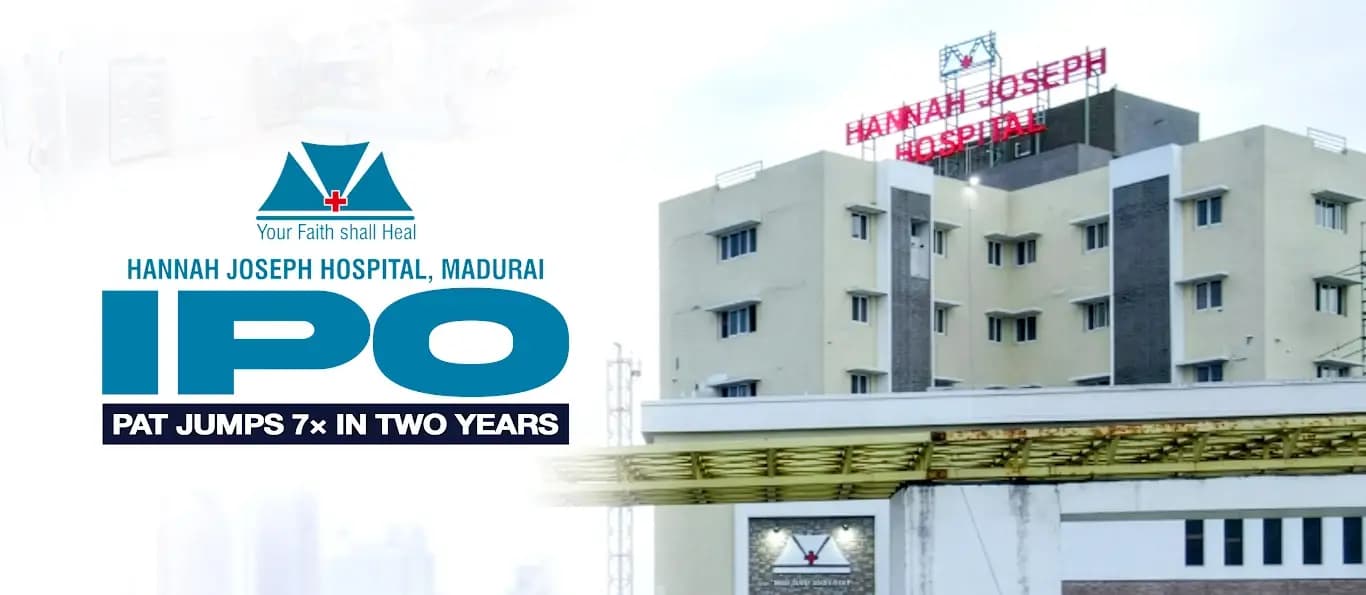
Hannah Joseph Hospital Limited is a specialty-focused tertiary care hospital based in Madurai, with a strong emphasis on neurosurgery, neurology, trauma, and critical care.
The hospital operates a high-acuity, procedure-led model supported by advanced technologies such as AI-assisted neuro-navigation, enabling treatment of complex cases typically referred to metro centers me.
IPO Details
Company Origin Story
The institution traces its roots to 2008 when Dr. Moses joseph Arun Kumar, neurosurgeon, established "Hannah Joseph Hospital" as a sole proprietorship in Madurai, Tamil Nadu. The primary objective at inception was to provide a comprehensive range of specialized neurology and neurosurgery services to the region. The entity was formalized as a corporate body on October 24, 2011, incorporating as "Hannah Joseph Hospital Private Limited". The company was founded by Dr. Arun Kumar alongside his spouse, Dr. Fenn Kavitha Fenn Arun Kumar, a consultant psychiatrist and Whole-time Director, who has been associated with the hospital since its inception. A significant milestone in the company's history occurred in 2020 when the hospital relocated to a new, larger campus spread over 2 acres to accommodate increased bed capacity and infrastructure needs. Subsequently, in July 2022, the company converted from a private limited entity to a public limited company, rebranding as "Hannah Joseph Hospital Limited" to facilitate further growth and capital raising.SME
Industry Overview: Indian Healthcare Sector
The Indian healthcare sector has emerged as one of the largest in the country in terms of both revenue and employment. It is currently growing at a robust pace, driven by strengthening coverage, improved services, and increasing expenditure by both public and private players.The sector was valued at ₹54,67,022 crore (US$ 638 billion) by 2025. The industry is growing at a Compound Annual Growth Rate (CAGR) of 17.5-22.5%. Specifically, the hospital market was valued at $126.0 billion in 2024 and is projected to reach $193.59 billion by 2032.
There is a surge in demand for health insurance, which increased by 321% post-COVID. Gross direct premium income for health insurance rose to ₹37,528.92 crore in March 2025. This financial protection aids the rise in healthcare spending. India is also a cost-competitive destination, with surgery costs roughly one-tenth of those in the US or Western Europe. The medical tourism market is valued at $7.69 billion (2024) and is expected to grow to $14.31 billion by 2029 at a CAGR of 13.23%.
The Indian healthcare delivery system is bifurcated, with the Private Sector emerging as the dominant provider of secondary, tertiary, and quaternary care. While the public sector focuses on primary healthcare in rural areas, the private sector caters to the demand for specialised high-end treatments in metros and Tier-I/II cities. The private sector is expected to add over 4,000 beds in FY26 with investments of roughly ₹11,500 crore. This segment is currently capitalising on significant demographic shifts, particularly an ageing population—with the median age projected to rise from 28.8 years in 2025 to 38.3 years by 2050—which directly correlates to an increased burden of lifestyle diseases requiring specialised interventions in fields like Neurosciences and Cardiac Sciences.
Business Model
Hannah Joseph Hospital Limited operates a single-location, speciality-focused tertiary care hospital with a dominant presence in neurosciences and trauma care. It positions itself as an "international centre of excellence" in these fields. Over time, the hospital has diversified its clinical portfolio to include Cardiac Sciences (interventional cardiology and open-heart surgeries), Psychiatry, and Orthopedics to capture a broader patient base. The business model is built around high-acuity, procedure-intensive medical services, where clinical outcomes, specialist reputation, and infrastructure depth drive patient inflow rather than price-led competition. Unlike multi-city hospital chains that rely on rapid replication, Hannah Joseph follows a centre-of-excellence model, where scale is achieved through case complexity, bed utilisation, and operating leverage within a concentrated geography. This model prioritises clinical depth and margin sustainability over footprint expansion. The hospital operates a 150-bed facility (with 133 beds currently operational) with high ICU and critical-care bed proportion. The infrastructure includes advanced diagnostic and surgical technology, such as Brainlab Navigation, and high-end neuro-cath labs.
Technology Advancement
Hannah Joseph Hospital’s clinical differentiation is strongly anchored in its advanced neurosurgical technology stack, particularly the deployment of AI-assisted navigation systems for complex brain and spinal surgeries.
1. Brainlab Fibre Tracking 3.0 is an advanced neuro-navigation and tractography system that maps critical neural fibre pathways in the brain in three dimensions. Using pre-operative MRI and diffusion tensor imaging (DTI), the system enables surgeons to visualise motor, sensory, and language tracts in real time during surgery. This allows precise tumour resection while minimising damage to vital brain functions. Improves surgical accuracy and safety in deep-seated and high-risk brain tumours. Brainlab functions as an AI-assisted decision-support platform. The company was first to launch this technology in South Asia.
2. CUSA (Cavitron Ultrasonic Surgical Aspirator) is an advanced surgical system widely used in complex neurosurgeries and tumour resections. CUSA uses ultrasonic vibrations to selectively fragment soft pathological tissue, while simultaneously irrigating and aspirating it, enabling surgeons to remove tumours with minimal damage to surrounding healthy brain structures.CUSA is typically used in conjunction with AI-assisted navigation systems such as Brainlab Fibre Tracking 3.0, where Brainlab provides real-time anatomical guidance, and CUSA acts as the precision execution tool during tumour removal. This combination materially enhances surgical accuracy and outcomes.
3. Cath Lab supports cardiology and cardiothoracic interventions such as angiography, angioplasty, and device implantation. This expands the hospital’s scope beyond neurosurgery into procedure-led cardiac care, improving infrastructure utilisation.
Revenue Stream and Mix
Revenue Streams by Segment ( Values in INR Cr)
Revenue Breakup from Healthcare Services ( Values in INR Cr)
Government Schemes: The hospital also run government-sponsored health insurance schemes, which are crucial for new patient registrations. These include:
Tamil Nadu New Health Insurance Scheme (TNNHIS): For state government employees of Tamil Nadu.
Chief Minister’s Comprehensive Health Insurance Scheme (CMCHIS): For beneficiaries identified through the Socio-Economic Caste Census.
Management + Promoters
Dr. Mosesjoseph Arunkumar (Chairman and Managing Director): He is the primary promoter and has been associated with the company since its incorporation. A neurosurgeon with over 25 years of experience, he holds an M.B.B.S, M.Ch., and D.N.B. Previously, he served as a consultant at CMC Hospital, Vellore, and Apollo Speciality Hospital, Madurai. He is responsible for the overall management of the company.
Dr. Fenn Kavitha Fenn Arunkumar (Whole-time Director): Spouse of Dr. Arunkumar, she is a Consultant Psychiatrist holding an M.B.B.S, D.P.M., and D.N.B in Psychiatry. She has over 22 years of experience and is also the founder of "Youforia Danscool." She oversees policy implementation and business strategy execution..
Next Generation: The promoters' children, Arunkumar Nalina (MBBS, pursuing Neurosurgery) and Noyel Arunkumar (pursuing MBBS), serve as Non-Executive Directors.
Detailed Shareholding Breakdown:
Provision of Comprehensive Care Under One Roof: Currently, the hospital specializes in neurosurgery; the new centre will allow patients with brain and spinal cord tumors to receive radiation therapy and chemotherapy within the same facility, eliminating the need to refer them to other institutions. This "comprehensive treatment under one roof" model ensures continuity of care and convenience for patients.
Access to Advanced Precision Technology The centre will be equipped with a Medical Linear Accelerator (LINAC), specifically the Elekta INFINITY Digital Linear Accelerator, which improves care through high-precision delivery. This technology enhances treatment by:
Targeted Destruction: Delivering high-energy x-rays or electrons to destroy tumor cells while sparing surrounding normal tissue.
Advanced Techniques: Enabling sophisticated treatment modalities such as Intensity-Modulated Radiation Therapy (IMRT), Volumetric Modulated Arc Therapy (VMAT), Image-Guided Radiation Therapy (IGRT), Stereotactic Radiosurgery (SRS), and Stereotactic Body Radio Therapy (SBRT).
Triple Photon Energy: The equipment offers versatile energy outputs (6MV, 10 MV, and 15MV) to treat various types of cancers effectively.
Holistic and Multidisciplinary Approach The centre is designed to move beyond just surgical intervention. It will implement a multidisciplinary approach, bringing together leading oncologists, surgeons, radiologists, and support staff to provide holistic care. The scope of services will cover the entire patient journey, including, early detection and advanced diagnostic imaging., targeted therapies and chemotherapy, palliative care for symptom management and quality of life.
Seamless Integration and Accessibility The new facility is being constructed on land adjacent to the current hospital campus, ensuring seamless physical integration with the existing 150-bed multi-specialty facility. This proximity facilitates immediate access to the hospital's existing neurosurgery, critical care, and emergency departments.
Financial Analysis ( Values in INR Cr)
The company has witnessed a compound annual growth in revenue, driven primarily by an increase in patient volumes (both In-patient and Out-patient) rather than just price hikes. Out-patient volume jumped from 6,030 in FY23 to 7,487 in FY25. The ARPOB (Average Revenue Per Occupied Bed) has consistently risen from ₹21,927 (FY23) to ₹30,118 (Sept '25). This suggests the hospital is handling more complex, higher-value cases (Neuro/Trauma) which command better pricing. While revenue grew by 22.28% in FY25, total expenses grew by only 15.90%. This positive jaw ratio indicates strong operational leverage.A critical driver for the PAT surge (from ₹1.01 Cr in FY23 to ₹7.20 Cr in FY25) is the aggressive reduction in finance costs. Finance costs dropped from 11.72% of total income in FY23 to just 4.46% in FY25. Despite inflationary pressures on medical consumables and employee costs, the company maintained an EBITDA margin above 26%, which is healthy for a hospital of this size.
Capacity Headroom: The current bed occupancy is roughly 42% (FY25). While this is an improvement from previous years, it indicates the hospital is currently underutilizing its infrastructure. This is a double-edged sword: it implies a risk of fixed-cost absorption but also offers a significant opportunity to scale revenue without immediate additional capex on beds. An Average Length of Stay (ALOS) of 14-15 days is significantly higher than the general multi-specialty average (usually 3-5 days). This confirms the hospital's niche in Neurosciences and Trauma, where recovery times are longer. While this ensures steady occupancy per patient, it limits patient turnover velocity.
Peer Analysis
IPO Objectives
Funding Capital Expenditure for a New Radiation Oncology Centre The company plans to deploy the majority of the Net Proceeds, specifically estimated at ₹34.98 Cr, to establish a Radiation Oncology Centr. The total cost of this project is estimated at ₹43.23 Cr, with the difference being funded through internal accruals (specifically the land cost).
The expenditure breakdown for this objective includes:
Construction: Civil and interior works, including structures and MEP (Mechanical, Electrical, Plumbing) services for the building.
Medical Equipment: A significant portion (approx.₹21.78 Cr) is allocated for purchasing advanced machinery, specifically a Medical Linear Accelerator (LINAC) from Elekta Solutions AB (Sweden) and other related equipment.
Through the LMVT Framework
Leadership:
A founder-led, clinician-driven hospital anchored by Dr. Mosesjoseph Arunkumar’s deep expertise in neurosurgery and supported by strong psychiatric leadership. Clinical reputation and hands-on promoter involvement have built referral-led demand, though the model remains dependent on key doctors and succession planning.
Moat:
Hannah Joseph Hospital’s edge lies in its high-acuity neurosciences focus, advanced technology stack (AI-assisted navigation, CUSA, cath lab), and inpatient-heavy monetisation that delivers superior ARPOB and margins. The moat is operational, not structural—replicable with capital, specialist talent, and time, but difficult to execute well outside metro centres.
Valuation:
At ~13.5× P/E, the IPO is fairly priced for a specialty tertiary-care hospital with mid-20% EBITDA margins and improving ROCE. Upside rerating hinges on consistent cash-flow conversion, sustained occupancy gains from current underutilisation, and timely commissioning of the radiation oncology centre.
Tailwinds:
Rising demand for high-end tertiary care, increasing insurance penetration, regional referral inflows for complex neuro/trauma cases, and operating leverage from capacity headroom support medium-term growth. The radiation oncology addition could deepen case complexity and improve ARPOB if executed on schedule.
Bottom Line:
Hannah Joseph Hospital is a high-acuity, margin-led specialty hospital transitioning into a more comprehensive oncology-enabled platform. Strong clinical credentials and technology-driven differentiation are positives, while single-location concentration, execution risk on new capex, and cash-flow discipline remain key monitorables. Investor returns will depend on converting utilisation gains into durable cash flows while maintaining clinical excellence post expansion.
0

5

0
Publish Date
21 Jan 2026
Category
SME IPO
Reading Time
14 mins
Social Presence


Table Of Content
Introduction
Industry Overview: Indian Healthcare Sector
Management + Promoters
Financial Analysis ( Values in INR Cr)
IPO Objectives
Tags
SME IPO
HANNAH HOSPITALS IPO
HANNAH HOSPITALS IPO REVIEW

Office Address: MiQB, Plot 23, Sector 18, Maruti Industrial Development Area, Gurugram, Haryana 122015
Registered Office Address: 1001, Block G1B, Pocket-1, Phase-2, Samriddhi Apartments, Dwarka Sector-18B, New Delhi-110078
Email: help@alphaamc.com • Phone: +91-93-1137-8001
Alpha Ventures Private Limited
(Formerly known as Planify WealthX Pvt Ltd)
Sponsor Name
Planify Venture LLP
Investment Manager
Fund Managers
VentureX Fund I (SME)
Disclaimer
You acknowledge and confirm that by accessing the website, you are seeking information relating to the organisation of your own accord and that there has been no form of solicitation, advertisement or inducement by the organisation. Any part of the content is not, and should not be construed as, an offer or solicitation to buy or sell any securities or make any investments or any products. No material/information provided on this website should be construed as investment advice. Any action on your part on the basis of the said content is at your own risk and responsibility.
Financial Documents
Policies
© 2024–2025 Alpha. All rights reserved, Built with ❤️ in India

