
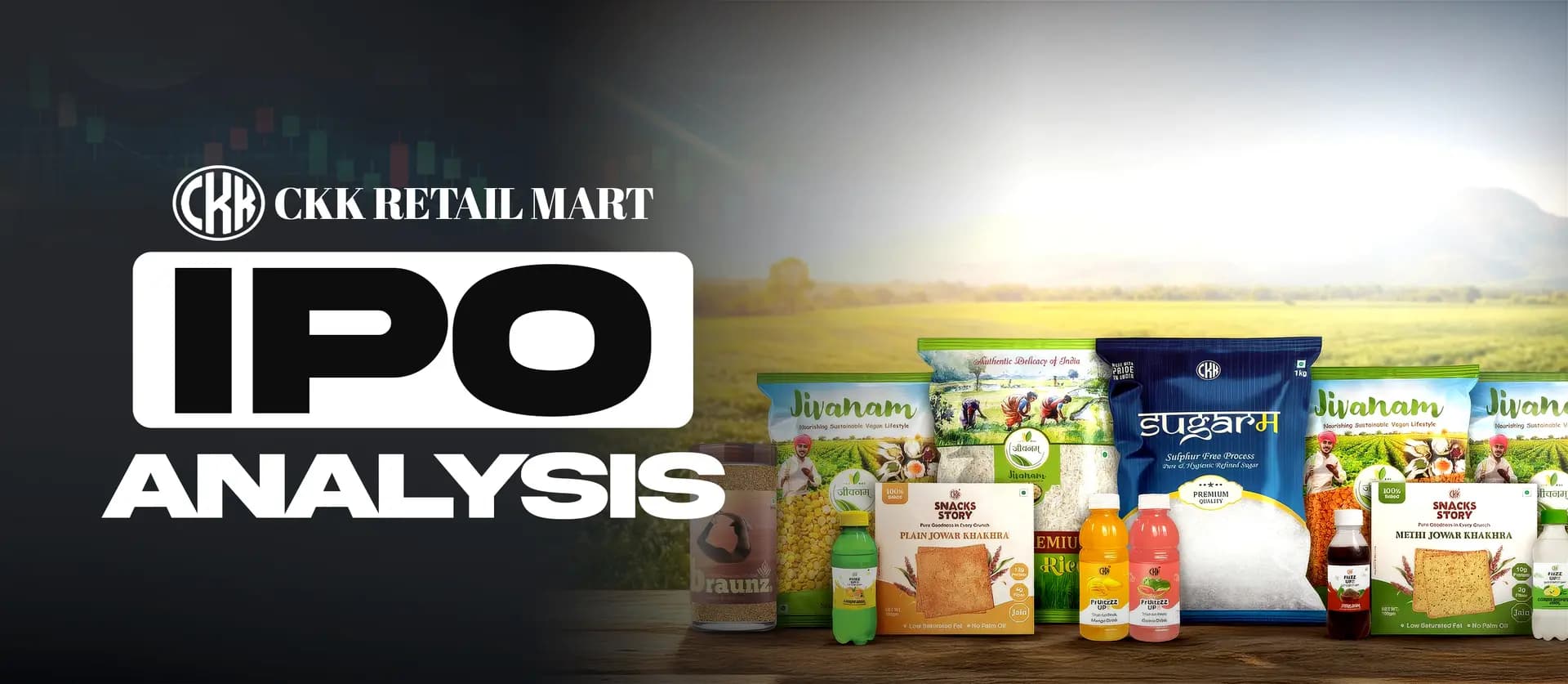
CKK Retail Mart Limited is entering the public markets as a sugar and packaged agro-commodities distributor, operating in a highly cyclical sugar industry with an asset-light, working-capital-efficient model, making its IPO a key test of scalability, diversification into beverages, and earnings sustainability in India’s evolving FMCG and agri-trading landscape.
Let's explore further:
Before the Deep Dive: What’s Working — and What Isn’t
Now that you’ve seen the snapshot, let’s unpack the full story behind these numbers and understand the business in context.
Indian Sugar Industry Outlook and Beverage Market Growth
India’s sugar industry is structurally stronger than before but remains highly cyclical and policy-dependent. With production of ~32–34 million tonnes and the 20% ethanol blending target by 2025–26, cash-flow stability has improved, yet the industry continues to face price volatility, periodic oversupply, and regulatory uncertainty. While domestic consumption offers a baseline of demand, earnings remain sensitive to government interventions, monsoon conditions, and global sugar prices, making long-term visibility uneven despite recent structural improvements.
The Indian non-alcoholic beverage industry, valued at USD 23.51 billion in 2024, is projected to nearly double to USD 46.06 billion by 2033, reflecting a healthy CAGR of 7.76%, driven by urbanisation, rising incomes, warmer climate patterns, and deeper penetration in Tier II and III cities. Improved cold-chain infrastructure, digital distribution, and supportive food-processing policies are enabling branded players to scale efficiently, with premiumisation and product diversification emerging as key long-term growth drivers.
Business Overview
Incorporated in 2005, CKK Retail Mart Limited began operations with a focus on trading and distribution of essential consumer products. Over the years, the company has evolved into a B2B-focused player, primarily engaged in the procurement, trading, and distribution of sugar and beverage-related products, catering to institutional buyers and distribution partners.
Since FY2023, the company has sharpened its focus on the trading and distribution of packaged agro-commodities such as sugar, rice, pulses, and ghee, with a growing footprint across Maharashtra, Bihar, West Bengal, and the north-eastern states. In April 2025, the company expanded into the branded beverages space with the launch of “FruitzzzUp”, a fruit pulp-based juice brand, marking a strategic move towards higher-value, consumption-driven categories.
Business Model
C K K Retail Mart operates through two distinct distribution models, designed to balance scale, cash flow efficiency, and margin optimization across regions and product categories.
Under the three-tier distribution model, the company supplies products to super stockists, who then distribute to distributors, followed by onward sales to retailers and wholesalers. Super stockists purchase inventory on an upfront payment basis, providing immediate cash inflows and lowering credit risk for the company. While this structure results in lower per-unit realisation due to higher discounts to super stockists—pressuring gross margins—it significantly shortens the working capital cycle and enables high-volume distribution with reduced inventory and receivables risk.
In the direct-to-distributor model, the company supplies products directly to distributors, eliminating the super stockist layer. Distributors subsequently serve retailers and wholesalers, allowing for better price realisation, improved margin control, and faster market feedback. This model is typically deployed in regions or product categories where demand visibility is higher and credit risk is manageable, offering a more balanced trade-off between growth and profitability.
Products & Services
The company’s product portfolio spans essential, high-consumption categories. In sugar, it deals in packaged refined sugar catering to both retail and bulk institutional demand. The rice and pulses segment includes commonly consumed staple variants targeted at value-driven retail and wholesale markets. In milk powder, the company distributes packaged dairy-based products used across household and institutional channels.
Within beverages, the portfolio covers both carbonated soft drinks and fruit-based beverages, addressing mass-market consumption, alongside its fruit pulp-based juice offerings. Together, these categories allow the company to participate across daily essentials and discretionary consumption, ensuring steady demand across market cycles.
Model Wise Revenue
(₹ Lakhs)
Revenue is largely driven by the three-tier distribution model, which contributes over 90% of revenues and supports strong upfront cash inflows, significantly limiting receivables risk. This structure enables the company to scale volumes efficiently while keeping the working capital cycle tight, with the direct-to-distributor model used selectively where margin visibility is higher.
Super Stockist and Distributor Network
While the distributor network has expanded overall, the frequent additions and deletions across wholesalers and superstockists point to some volatility in channel partnerships. This suggests ongoing optimisation, but also indicates that network stability and partner retention will remain key areas to watch going forward.
Revenue Bifurcation—Product Wise
(₹ Lakhs)
The revenue mix is heavily concentrated in sugar, contributing ~98–100% of total revenues across periods, which exposes the business to commodity price volatility and policy risk. Other categories like beverages, rice, pulses, and dairy remain immaterial and inconsistent, raising questions around the scalability and execution of diversification efforts. Sustained dependence on a single product category remains a key risk to monitor.
Revenue Bifurcation—Geography Wise
The company’s domestic revenues are highly concentrated, with West Bengal (~55% in H1 FY26; ~34% in FY25) and Bihar (~20% in H1 FY26; ~18% in FY25) accounting for a majority of sales. Maharashtra’s contribution has declined materially, from ~45% in FY23 to ~12% in H1 FY26, while other states such as Assam, Telangana, Andhra Pradesh, and Karnataka remain smaller and inconsistent contributors.
Exports form a limited share of revenues at ~4–5% in H1 FY26, primarily to the UAE (~3.7%), with Tanzania (~0.8%) and Singapore contributing marginally, underscoring the company’s narrow geographic and export concentration.
Manufacturing & Sourcing Arrangement
The company follows an asset-light manufacturing model through third-party arrangements. It has entered into manufacturing and supply agreements with Bee Ventures and Pure Foods and Beverages in Thane, Maharashtra, under which “Fizzz Up” and “Fruitzz Up” beverages are manufactured and packed under the company’s brand. For agro-products, raw materials are procured from external suppliers, brought to third-party facilities for quality checks and packaging, with all manufacturing facilities owned and operated by third parties, not by the company.
Financial Performance
Revenue growth has been healthy, with revenues rising from ₹10,327 lakh in FY23 to ₹30,119 lakh in FY25 (29.2% YoY in FY25), though this has been driven almost entirely by the sugar segment. While scale-up is encouraging, future growth visibility will depend on whether the beverage portfolio can meaningfully contribute, as non-sugar revenues currently remain negligible.
Margins have stayed largely flat, with EBITDA margins at ~7.4–7.5% and PAT margins at ~5.4%, which is typical for sugar trading businesses and offers limited scope for expansion without product mix improvement. On the balance sheet side, the cash conversion cycle improved to ~28 days in FY25 from 47 days in FY23, aided by lower receivables (~25 days) under the three-tier model, supporting a debt-free and working-capital-efficient operating structure.
Management Analysis
The company is led by Saurabh Malhotra, the promoter with experience in sugar and agro-commodity trading. The management has shown strong execution on the operating side, scaling revenues while maintaining a debt-free balance sheet and improving working capital efficiency, reflected in lower receivables and a tighter cash cycle.
That said, investors should be mindful of ongoing litigations involving the promoter and group entities. These include criminal proceedings under the Negotiable Instruments Act related to a ₹13.1 crore cheque dishonour linked to sugar export transactions, and an older FIR alleging fraud in export dealings, where only ₹70 lakh of the alleged amount was ultimately given by promoters— leaving 10 lakh amount due; and the matter is now pending alongside a related civil recovery suit. In addition, there is a civil execution case concerning unpaid dues of ~₹1.76 crore, where enforcement has currently been stayed by the Karnataka High Court. While none of these proceedings involve regulatory actions against the company itself, their outcomes remain a governance and overhang risk to monitor.
Peer Analysis
(in crores)
C K K Retail Mart operates at a much smaller scale (₹301 crore revenue) compared to sugar peers like Mawana Sugars and Shree Renuka Sugars, making direct valuation comparisons misleading. While C K K’s EBITDA (7.5%) and PAT margins (5.4%) are broadly in line with sugar trading economics, its ROE of ~48% is significantly higher, driven by an asset-light, low working capital model.
That said, these peers differ materially in business models, scale, integration levels, and cyclicality, meaning the comparison is not apple-to-apple.
IPO Objectives
₹1,020 lakh towards acquisition of leasehold warehouse properties.
₹190 lakh for repair and refurbishment of existing warehouses.
₹4,300 lakh to meet working capital requirements, supporting scale-up of operations.
Balance towards general corporate purposes.
Final Words
Through the LMVT Framework
Leadership:
Experienced promoter-led management has delivered rapid scale-up, a debt-free balance sheet, and low CCC, but ongoing litigations and multiple promoter group entities remain governance watchpoints.
Moat:
An operational moat driven by the three-tier distribution model enables upfront cash flows and CCC of ~28 days, though pricing power is limited due to the commodity nature of sugar.
Valuation:
Strong return metrics (ROE ~48%, ROCE ~52% in FY25) reflect an asset-light structure, but sustainability hinges on diversification beyond sugar (~98–100% of revenue).
Tailwinds:
Support from domestic sugar demand, ethanol blending (20% by 2025–26), and beverage market growth (~7.8% CAGR), offset by policy risk, cyclicality, and execution risk in new segments.
Bottom line:
A working-capital-efficient, high-return business, but concentration and governance risks cap long-term visibility. Suitable for investors comfortable with commodity exposure and execution risk.
0

12

0
Publish Date
30 Jan 2026
Category
SME IPO
Reading Time
11 mins
Social Presence


Table Of Content
Business Overview
Super Stockist and Distributor Network
Financial Performance
Final Words
Tags
SME IPO
SME IPO Analysis
CKK Retail Mart IPO analysis
CKK Retail Mart IPO

Office Address: MiQB, Plot 23, Sector 18, Maruti Industrial Development Area, Gurugram, Haryana 122015
Registered Office Address: 1001, Block G1B, Pocket-1, Phase-2, Samriddhi Apartments, Dwarka Sector-18B, New Delhi-110078
Email: help@alphaamc.com • Phone: +91-93-1137-8001
Alpha Ventures Private Limited
(Formerly known as Planify WealthX Pvt Ltd)
Sponsor Name
Planify Venture LLP
Investment Manager
Fund Managers
VentureX Fund I (SME)
Disclaimer
You acknowledge and confirm that by accessing the website, you are seeking information relating to the organisation of your own accord and that there has been no form of solicitation, advertisement or inducement by the organisation. Any part of the content is not, and should not be construed as, an offer or solicitation to buy or sell any securities or make any investments or any products. No material/information provided on this website should be construed as investment advice. Any action on your part on the basis of the said content is at your own risk and responsibility.
Financial Documents
Policies
© 2024–2025 Alpha. All rights reserved, Built with ❤️ in India

