

India’s Top Performing Alternative Investment Funds
Introduction
With millions of investors using Systematic Investment Plans, India's stock markets have grown a lot over the past ten years. This growth happened because of retail money flowing into the markets. Mutual funds are now a choice for many Indian investors. This is because more people are investing, and the number of investors has increased rapidly.
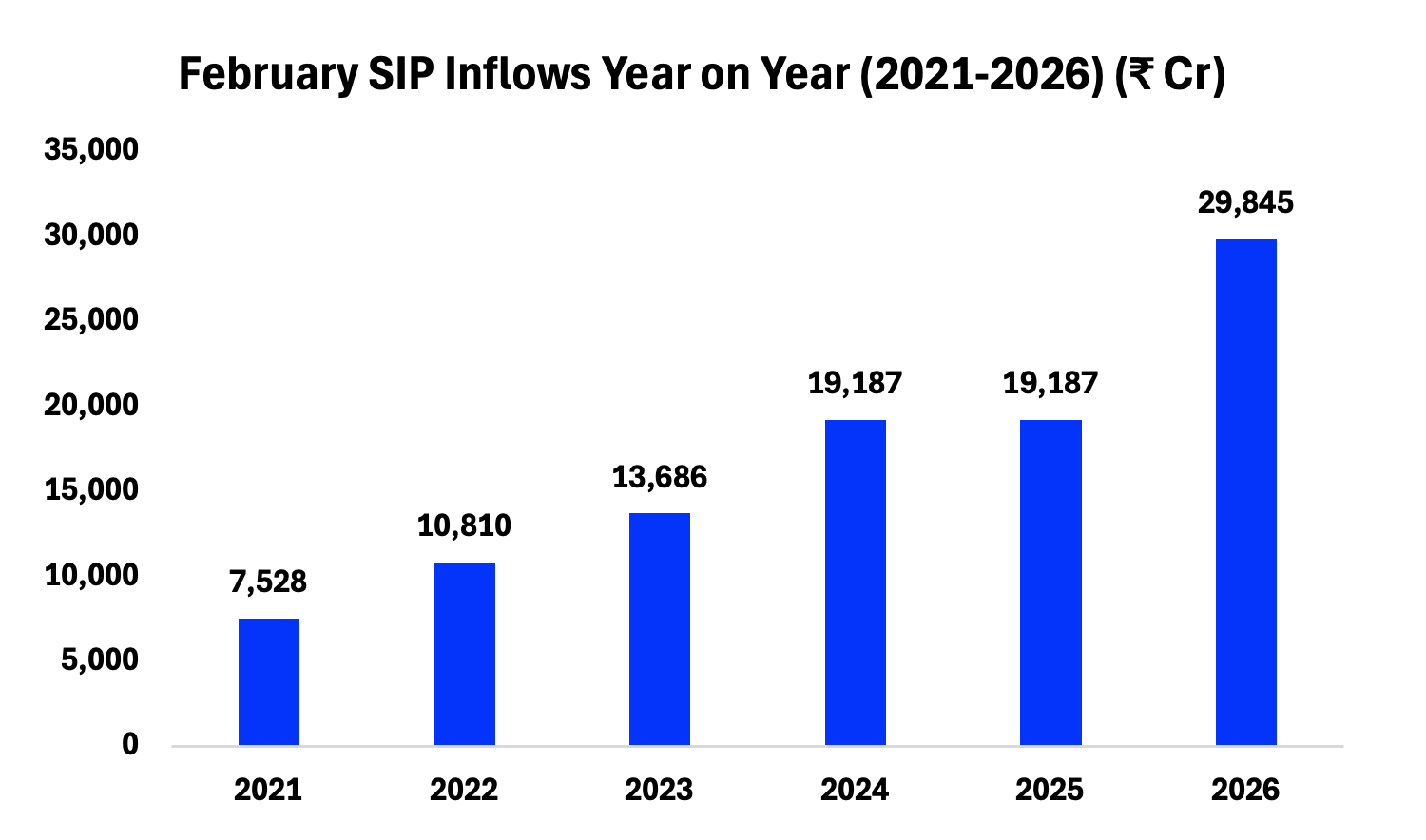
As of February 2026, the mutual fund industry manages around ₹82 lakh crore. It is expected to grow by more than 18% each year for the next five years. This growth is driven by monthly SIP inflows of ₹30,000 crore, highlighting strong and consistent retail participation
Over the past ten years, investments in passive funds have also grown. Passive funds now account for a significantly higher share of equity mutual fund assets, rising sharply over the past decade as markets become more efficient. This is also due to the market's growing perception of moving towards greater efficiency.
But underlying this phenomenon is something more interesting: the rising importance of Alternative Investment Funds as the consistent outperformers.
The Alternative Investment Fund sector in India has grown at a rapid pace, with commitments of over ₹15 lakh crore and investments of over ₹4.5 lakh crore as of December 2025. Category II AIFs have seen significant traction with over 80% of the total deployed capital.
Whereas the mutual fund and passive investing space are primarily driven by market beta, the Alternative Investment Fund sector offers strategy-based returns with greater downside protection and access to opportunities beyond public markets – factors that are increasingly attracting the attention of HNIs and institutions alike.
Moving Beyond Beta: How Alpha Is Evolving in India
Earlier, mutual funds could outperform due to information gaps and limited participation. That edge has narrowed. Today, over 80% of Nifty 500 companies are covered by institutional research, algorithmic trading contributes to more than half of market volumes, and institutional participation, both domestic and foreign, has increased significantly.
As a result, beating benchmarks consistently has become harder. Over five years, roughly 60–70% of large-cap mutual funds have underperformed their benchmarks.
AIFs, however, have carved out a different edge.
Across more than 100 strategies, recent trends show:
Many AIFs generate positive returns even in volatile markets
Performance varies widely, with top funds outperforming median ones by 2–3x
Returns depend more on execution and positioning than market direction
For example, in May 2025, 128 out of 133 AIFs delivered positive returns. Long-only AIFs returned 5.69% in a recent strong month, significantly higher than the Nifty 50’s 1.7% during the same period.
This highlights a key shift: alpha today is less about picking stocks and more about how capital is deployed and strategies are designed.
The Underrated Strength: Downside Protection
Returns get attention, but risk management is where AIFs often stand out.
During the recent market correction:
Long-only AIFs fell ~1.15%
Nifty 50 TRI fell ~2.77%
In a weak January:
Long-short AIFs declined ~1.45%
Broader indices dropped over 3%
Even during sharper corrections like FY20, several hedged AIF strategies limited losses to single digits while markets fell over 20%.
These differences may seem small in the short term, but over time they compound meaningfully. A 5% smaller drawdown can improve long-term CAGR by 200–300 basis points.
Mutual funds, being largely long-only with limited cash flexibility, remain exposed during downturns. AIFs, on the other hand, can hedge, adjust exposure, or even profit in falling markets.
Where the Alpha Comes From
AIF performance is driven by specific strategies rather than broad market exposure.
Long-Only Category III AIFs
The portfolios are identical in that they may have many features of the Mutual Funds - flexibility, as well as the ability to concentrate a portfolio on 15-25 stocks (if compared to a traditional mutual fund, you typically would have 50-70). The additional properties of the portfolios are that they possess a higher percentage of mid-cap and small-cap stocks. Their annualised returns have exceeded 35% to 45% in the last three years, compared to 18% to 22% for mid-cap mutual funds. Their advantage is based on the concentrated nature of the portfolio stocks, the amount of "thematic" exposure and longer holding periods.
Long-Short Equity AIFs
Among the most sophisticated strategies, these funds can go both long and short. In FY25, they delivered around 8.68% returns with 30–40% lower volatility than long-only strategies. With net exposure typically between 30–60%, they reduce dependence on market direction and perform well in sideways or uncertain conditions.
Structured Credit AIFs
Often overlooked, these Category II funds focus on lending opportunities in private markets. With India’s private credit market exceeding $60 billion and growing, these funds typically generate 10–14% returns with downside protection through collateral and structured deals. They act as enhanced fixed-income instruments.
Special Situations and Distressed Funds
These funds target opportunities in insolvency, restructuring, and stressed assets. With over 7,000 IBC cases in India, the opportunity set is large. These strategies often aim for 18–25% IRRs, benefiting from limited competition and the ability to acquire assets at discounts.
Pre-IPO and Private Equity AIFs
These provide access to companies before listing, capturing early-stage value. Investors often benefit from 20–40% valuation discounts and pre-listing growth. In many IPOs, 30–40% of value creation happens before listing—captured largely by AIF investors.
Institutional Participation Is Rising
A major shift is the growing role of domestic institutional capital. Domestic investors now contribute over 50% of capital in Category I and II AIFs, compared to foreign dominance a decade ago.
Participants include family offices, corporate treasuries, and selective pension and insurance allocations. These investors tend to be long-term, data-driven, and highly selective—signalling confidence in AIFs’ ability to deliver risk-adjusted returns.
Why AIFs Have a Structural Edge
Several factors explain their outperformance:
Flexibility in allocation and concentration
Access to both public and private markets
Advanced risk management tools like hedging and derivatives
Performance-linked incentives align managers with investors
Fewer regulatory constraints also allow faster and more precise execution of niche strategies.
Category I AIFs typically focus on early-stage and growth capital opportunities, including unlisted SMEs and pre-IPO companies. However, certain strategies have evolved to participate in publicly listed SME and small-cap segments, capturing inefficiencies in less researched parts of the market.
This is reflected in strategies such as Alpha AMCs Category I AIFs, which invest in listed SME and emerging companies, leveraging information asymmetry and limited institutional coverage to generate alpha.
By focusing on underfollowed segments of the market, these strategies aim to capture high-growth opportunities ahead of broader institutional participation.
AIFs are highly manager-dependent.
Top funds can outperform median returns by 2–3x
Bottom funds may underperform even fixed-income funds
Unlike mutual funds, where returns are tightly clustered, AIF outcomes vary widely. Choosing the right manager, strategy, and timing is critical.
Key Risks
AIFs come with trade-offs:
Complex structures and strategies
Heavy reliance on the manager's skill
High minimum investment (typically ₹1 crore)
The Bottom Line
As Indian markets become more efficient and passive investing grows, generating alpha through traditional methods is getting harder.
AIFs offer a different path, one that focuses on strategy, flexibility, and access to opportunities beyond public markets. With stronger downside protection and the potential for better risk-adjusted returns, they are increasingly becoming a core part of sophisticated portfolios.
For investors who can handle complexity and think long term, AIFs present a compelling way to outperform traditional mutual funds and benchmark indices in India’s evolving investment landscape.
0

6

0
Publish Date
23 Mar 2026
Category
Ideas
Reading Time
7 mins
Social Presence


Table Of Content
Introduction
Moving Beyond Beta: How Alpha Is Evolving in India
Where the Alpha Comes From
Why AIFs Have a Structural Edge
The Bottom Line
Tags
AIF
NRI
mutualfunds

Office Address: MiQB, Plot 23, Sector 18, Maruti Industrial Development Area, Gurugram, Haryana 122015
Registered Office Address: 1001, Block G1B, Pocket-1, Phase-2, Samriddhi Apartments, Dwarka Sector-18B, New Delhi-110078
Email: help@alphaamc.com • Phone: +91-93-1137-8001
Alpha Ventures Private Limited
(Formerly known as Planify WealthX Pvt Ltd)
Sponsor Name
Planify Venture LLP
Investment Manager
Fund Managers
VentureX Fund I (SME)
Disclaimer
You acknowledge and confirm that by accessing the website, you are seeking information relating to the organisation of your own accord and that there has been no form of solicitation, advertisement or inducement by the organisation. Any part of the content is not, and should not be construed as, an offer or solicitation to buy or sell any securities or make any investments or any products. No material/information provided on this website should be construed as investment advice. Any action on your part on the basis of the said content is at your own risk and responsibility.
Financial Documents
Policies


© 2024–2025 Alpha. All rights reserved, Built with ❤️ in India