
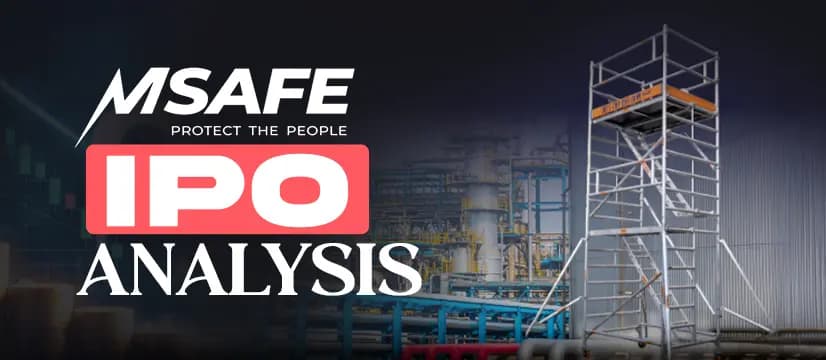
This IPO analysis of Msafe Equipments Limited breaks down the key numbers behind one of India’s emerging SME IPOs, covering its scaffolding and access equipment business, rental-led revenue model, financial performance, valuation, risks, and what investors should realistically expect from this construction equipment IPO.
Before the Deep Dive: What’s Working — and What Isn’t
Now that you’ve seen the snapshot, let’s unpack the full story behind these numbers and understand the business in context.
Industry Overview
The India Scaffolding Market studied was valued at INR 7208.97 crores in 2024 and is expected to reach INR 12811.78 crores in 2030, registering a CAGR of 10.06% for the forecast period (2024-2030). The scaffolding industry is moving away from traditional bamboo and basic mild steel pipes to advanced, safety-certified systems like cup lock, ring lock, and Aluminium stairway towers. Aluminium scaffolding is becoming increasingly popular due to its lightweight nature, ease of transportation, rapid assembly, corrosion resistance and extended lifespan.
The India Ladders Market was valued at Rs. 1,358.27 crores in 2024 and is expected to reach Rs. 2,233.90 crores in 2030, registering a CAGR of 8.65% for the forecast period (2024–2030). Growth in this sector is driven by infrastructure development, urbanization, industrial expansion, stringent safety regulations, and innovations in ladder design and materials.
What’s really moving the needle is government spending with NIP, PM Gati Shakti, Smart Cities Mission, affordable housing, and a sustained push in industrial capex are structurally lifting demand for safe, standardized access systems.
Business Origin Story
Founded in 2019, Msafe Equipments Limited was built to address a clear gap in India’s construction and industrial ecosystem—the lack of organized, safety-compliant access equipment. The company designs and manufactures scaffolding systems, ladders, and related access solutions used across construction, infrastructure, and industrial maintenance. Starting as a focused manufacturer, Msafe has steadily scaled alongside India’s infrastructure push, positioning itself as a reliable supplier in a market shifting from unorganized players to quality- and compliance-driven solutions.
Business Model: Sales vs Rental-Led Revenue
Msafe operates a hybrid business model, offering both outright sales and equipment rentals, which allows it to address varied project timelines and client needs. Under the sales model, scaffolding systems and ladders are sold to customers with long-term or recurring requirements, largely institutional and industrial in nature.
The rental model caters to project-led demand, where equipment is rented out on weekly, monthly, or longer-tenure contracts, aligning with construction and infrastructure execution cycles. This model improves asset utilization while providing predictable, annuity-like cash flows. The company’s client base includes infrastructure contractors, construction companies, EPC players, industrial units, and maintenance service providers, for whom safety compliance, quality, and timely availability are key decision drivers.
Products and services offered
Aluminium Scaffoldings
These are lightweight, corrosion-resistant scaffolding systems used where ease of movement, faster installation, and repeated deployment matter. Aluminium scaffoldings are typically preferred in industrial maintenance, plant shutdowns, and indoor applications, where safety and efficiency are critical and downtime is costly.
Mild Steel (MS) Scaffoldings
MS scaffoldings form the heavy-duty backbone of Msafe’s offering. Designed for high load-bearing capacity, they are widely used in infrastructure projects, real estate construction, and large EPC sites. Their robustness makes them suitable for long-duration and structurally intensive projects.
Aluminium Ladders
Msafe’s aluminium ladders are built for industrial and commercial usage, offering a balance between strength and portability. These are commonly deployed in factories, warehouses, telecom, and maintenance operations, where frequent relocation and safe access at height are required.
Fibre Reinforced Plastic (FRP) Ladders
FRP ladders are specialized access solutions used in electrical, chemical, and hazardous environments. Their non-conductive and corrosion-resistant properties make them suitable for power plants, utilities, and process industries, where safety risks are higher.
Rental & Project-Based Services
In addition to product sales, Msafe provides scaffolding and access equipment on weekly, monthly, and project-tenure rental contracts. This service model supports contractors and EPC players with temporary or phase-wise requirements, while ensuring better asset utilization and recurring revenue visibility for the company.
Customer Base
Their customer base extends across a wide spectrum of industries, including civil construction, infrastructure development, facility management, HVAC solutions, MEP contracting, interior contracting, electrical contracting, warehousing and logistics, firefighting and safety systems, among others. During FY 2024-25, they served more than 2,500 customers through both sales and rental channels.
The company does not maintain a formal order book; instead, business visibility is driven by rental demand, with average monthly rental orders of ~₹370.8 lakh, highlighting the project-led and short-cycle nature of revenues.
Manufacturing Footprint: Three Sites, One Core Business
Msafe operates through three manufacturing sites, each broadly aligned to its core access and safety equipment business. The facilities are not diversified by end-market but are instead product- and process-aligned, supporting the same customer segments.
Site 1 – Core Scaffolding Manufacturing
This facility is primarily used for the manufacturing of aluminium and mild steel (MS) scaffolding systems, which form the backbone of the company’s revenue, across both sales and rental segments. The site caters largely to project-led and institutional demand.
Site 2 – Ladder Manufacturing Unit
This unit focuses on aluminium ladders and fibre reinforced plastic (FRP) ladders, serving industrial, utility, and maintenance applications. Production here complements the scaffolding portfolio rather than adding a new business vertical.
Site 3 – Assembly, Storage & Rental Operations
The third site functions largely as a support and execution hub, handling assembly, storage, dispatch, and deployment of equipment, especially for the rental business, which operates on weekly, monthly, and project-based contracts.
Taken together, all three sites support the same underlying access equipment value chain, rather than distinct or independent business lines.
Group Companies & Subsidiaries: Structure and Business Overlap
Msafe operates through three group companies, identified under SEBI (ICDR) Regulations based on related-party transactions and promoter group linkage. While the group structure appears simple on paper, a closer look shows overlapping business lines and consolidation-led transitions, which merit attention.
1. MGRV Enterprises Private Limited (MGEPL)
Business: Aluminium scaffolding manufacturing (till FY23)
MGRV Enterprises was originally engaged in the manufacturing of aluminium scaffoldings, operating in a similar line of business as Msafe Equipments Limited. However, with effect from April 2023, all manufacturing activities were transitioned to the parent company, Msafe Equipments Limited, as part of a consolidation exercise.
Post this transition, MGRV has discontinued scaffolding manufacturing and is currently non-operational in this core business, with only limited ancillary activities continuing. The existence of a manufacturing subsidiary that later became dormant highlights business overlap in earlier years and subsequent structural rationalisation.
2. Mdeck Equipments Private Limited (MEPL)
Business: Ancillary and supporting components for scaffoldings
Mdeck Equipments is engaged in the manufacturing of supporting and ancillary components used in the assembly of aluminium and steel scaffoldings. While its Memorandum of Association permits similar activities as the parent, the company currently functions as a back-end support entity, supplying components to Msafe Equipments Limited.
Its operations are complementary rather than competitive, though it remains closely integrated into the same value chain, reinforcing the group’s dependence on a single core business segment.
3. Msafe Construction Equipment Trading L.L.C (MCETL)
Business: Trading of scaffolding and ladders
MCETL is a Dubai-based trading entity, engaged in the trading of scaffolding systems and ladders, with no manufacturing activities. The subsidiary caters exclusively to overseas markets, primarily Dubai and the broader Middle East region.
While the company does not overlap geographically with Msafe’s Indian operations, it operates in the same product category, extending the group’s exposure to a single business line across geographies.
What Stands Out:
All group entities are linked to scaffolding and access equipment, either through manufacturing, component supply, or trading.
One subsidiary (MGRV Enterprises) previously operated in the same manufacturing business as the parent and is now largely non-functional, following consolidation.
The group structure reflects operational layering around a single core activity, rather than diversified verticals.
While the company states that there is currently no conflict of interest, the presence of multiple entities with similar objects, including a dormant manufacturing subsidiary, introduces structural complexity and governance considerations that investors should monitor as the business scales.
Revenue Breakdown: Product Wise
The revenue mix shows a business still centered on aluminium scaffolding, which consistently contributes ~36–37% of topline, while rental services remain the primary growth driver, accounting for over 50% of revenue in FY24–FY25 before easing in H1 FY26. The company has also set up a dedicated unit for aluminium and FRP ladders, but despite this focused capacity, revenue contribution from ladders remains negligible at ~1%, indicating limited scale or traction so far. A notable change is the ramp-up in MS scaffolding sales, rising from near-zero levels in FY23–FY24 to ~10% of revenue in H1 FY26, suggesting a product-mix shift rather than broad-based volume growth.
At the same time, operating income remains elevated at ~9–10% of reported revenue, partly due to transportation charges being booked under other income while also appearing in other expenses—an accounting treatment that inflates topline without improving core operating profitability, making headline revenue growth look stronger than underlying execution.
Revenue Breakdown: Geography Wise
Revenue remains predominantly domestic, with India contributing ~97–99% of total turnover. Within India, the mix is highly concentrated, led by Maharashtra (~31% in FY25), followed by Karnataka, Uttar Pradesh, Tamil Nadu, and Gujarat—together accounting for over 70% of domestic revenue. Exports remain limited at ~2–3%, driven almost entirely by the UAE, while other countries contribute only sporadically. This geographic profile highlights strong presence in key construction-heavy states but also points to regional concentration risk and still-nascent export diversification.
Repeated Revenue
(₹ lakh)
Revenue from repeat customers has shown a structural improvement, rising from 31.2% in FY23 to 34.3% in FY24, before jumping sharply to 53.0% in FY25. This indicates improving client stickiness, particularly in the rental-led business where repeat usage is common. However, the share moderates to 26.3% in H1 FY26, suggesting that repeat revenues remain project-cycle dependent rather than fully annuity-like. While the FY25 spike is a positive signal, consistency across cycles will be key to assessing the durability of customer relationships.
Capacity Utilization
Unit 1
Unit 2
Unit 3
(Commercial operations commenced in May 2025)
Overall utilisation levels remain relatively high at ~80–85%, indicating decent operational intensity across units. However, Unit I shows a clear declining trend, with utilisation falling from 86.3% in FY24 to ~80% in H1 FY26, despite stable installed capacity. This suggests either demand moderation or execution inefficiencies, even before factoring in fresh capacity additions.
While Unit II has improved utilisation post-expansion, the addition of Unit III in FY25 increases overall capacity, raising the risk that incremental capacity could outpace demand. If volume growth does not scale in tandem, group-level utilisation could compress further, impacting operating leverage and margins. This makes capacity absorption a key monitorable going forward.
Financial Performance
(in lakhs)
The company has delivered strong topline momentum, with revenue growing sharply in FY24 and FY25, supported by a rising customer base and a clear expansion in EBITDA and PAT margins, which have improved to ~39% and ~21% respectively in H1 FY26. Leverage has reduced meaningfully, with debt-equity improving from 3.35x in FY23 to ~1.0x, strengthening the balance sheet.
However, this growth comes with working capital stress—inventory days have risen sharply, while payable days have compressed significantly, pushing the cash conversion cycle from negative in FY23 to over 200 days in H1 FY26. Returns, though still healthy, have also moderated from peak levels. Overall, the business shows strong operating traction and margin expansion, but sustainability of growth will depend on tighter working capital management and better cash flow discipline.
IPO Objectives
Capex for New Unit:
IPO proceeds will be used to set up and scale a new manufacturing unit, including basic infrastructure and plant setup, to expand in-house capacity and support future growth in core products.
Capex for Equipment:
The company will invest in machinery and equipment to improve production efficiency, quality, and turnaround time, while also expanding the owned equipment base for the rental business.
Working capital:
A portion of the IPO proceeds will be used to fund incremental working capital requirements, supporting higher inventory levels and receivables as the business scales, while easing near-term liquidity pressure.
Peer Analysis
Msafe stands out for its strong profitability, with EBITDA and PAT margins of 36.6% and 18.2%, far ahead of larger peers, and a high ROE of ~68%, indicating efficient capital use. The valuation at ~11.9x P/E appears reasonable given this margin profile. However, the company operates at a much smaller scale (₹71 crore revenue) and carries higher leverage (D/E ~1.3x), alongside a cash conversion cycle of ~112 days, reflecting working capital intensity. While growth and margins are key positives, sustainability of returns and balance-sheet discipline remain critical risks to monitor as capacity expands.
Management Overview
The company is promoted by Pradeep Aggarwal, Ajay Kumar Kanoi, Vansh Aggarwal, Rushil Agarwal, Gaurav Ajay Kumar Kanoi, Monika Agarwal, and Rajani Ajay Kanoi, who collectively bring operational and industry experience in scaffolding and access equipment. The promoter group currently holds 100% of the equity pre-IPO, which will reduce to ~73.53% post-issue, ensuring continued promoter control and alignment while allowing for public participation. While high promoter ownership provides stability and decision-making continuity, it also implies key-man and governance dependence, making execution discipline and transparency critical as the company transitions to a listed entity.
Final Words
Through LMVT Framework:
Leadership: The promoter group has built and scaled the business with strong operational control and continues to retain a 73.53% stake post-IPO, ensuring alignment. However, the business remains promoter-driven, with execution and governance closely tied to a small leadership group.
Moat: The company benefits from a rental-led, high-margin access equipment model, reflected in 36.6% EBITDA margins. That said, the moat is largely operational rather than structural, with limited pricing power and increasing exposure to capacity utilisation and project cycles.
Valuation: At ~11.9× P/E, the valuation appears reasonable relative to profitability and ~68% ROE. However, part of the return profile is supported by leverage (D/E ~1.3×) and elevated working capital (CCC ~112 days), making execution critical.
Tailwinds: Infrastructure spending and industrial capex provide medium-term demand visibility. Offsetting this are inventory build-up, falling utilisation at certain units, geographic concentration, and reliance on rental-led cash flows.
Bottom line: A profitable, fast-growing business with clear sector tailwinds and reasonable valuation, but sustainability of margins, working capital discipline, and governance quality will determine long-term returns. Suitable for investors comfortable with execution and cash-flow risk.
0

9

0
Publish Date
29 Jan 2026
Category
SME IPO
Reading Time
16 mins
Social Presence


Table Of Content
Business Origin Story
Manufacturing Footprint: Three Sites, One Core Business
Capacity Utilization
Peer Analysis
Tags
SME IPO
SME IPO Analysis
Msafe Equipments IPO
Msafe Equipments

Office Address: MiQB, Plot 23, Sector 18, Maruti Industrial Development Area, Gurugram, Haryana 122015
Registered Office Address: 1001, Block G1B, Pocket-1, Phase-2, Samriddhi Apartments, Dwarka Sector-18B, New Delhi-110078
Email: help@alphaamc.com • Phone: +91-93-1137-8001
Alpha Ventures Private Limited
(Formerly known as Planify WealthX Pvt Ltd)
Sponsor Name
Planify Venture LLP
Investment Manager
Fund Managers
VentureX Fund I (SME)
Disclaimer
You acknowledge and confirm that by accessing the website, you are seeking information relating to the organisation of your own accord and that there has been no form of solicitation, advertisement or inducement by the organisation. Any part of the content is not, and should not be construed as, an offer or solicitation to buy or sell any securities or make any investments or any products. No material/information provided on this website should be construed as investment advice. Any action on your part on the basis of the said content is at your own risk and responsibility.
Financial Documents
Policies
© 2024–2025 Alpha. All rights reserved, Built with ❤️ in India

